Institutionalising platform dependence: The paradox of the European Media Freedom Act
Abstract
The growing reliance of news organisations on platforms has profoundly affected journalism’s capacity to fulfil its role in democratic society. In response, the EU’s Media Freedom Act (EMFA) introduced a legally-binding media privilege that aims to protect journalistic content from platforms’ arbitrary content moderation mechanisms. While the EMFA represents a significant affirmation of journalism’s democratic value and the need for elevated legal protections, this article identifies a fundamental paradox at the core of the regulation: by entrusting critical procedural obligations to platform companies, the EMFA risks entrenching rather than mitigating platforms’ discretionary power over journalism. Drawing on interdisciplinary scholarship, we identify two structural reasons for this paradox: the EU’s consistent underestimation of platforms’ material interests and its overt reliance on procedural fairness and multistakeholder governance. We conclude that the EMFA’s procedural reliance on platforms prevents it from realising its normative ambitions regarding journalism’s democratic value and, more broadly, that bolder structural – not procedural – measures are required to rein in the hold that platform firms have over journalism.
Introduction
In late 2022, Elon Musk suspended journalists on X (formerly Twitter) tracking his flights, declaring: ‘you’re not special because you’re a journalist; you’re a citizen, so no special treatment’ (Grynbaum, 2022, n.p.). This episode is but an illustration of the risk to media freedom and access to information by leaving unchecked the power afforded to large online communication platforms and their owners. Indeed, scholars studying platform power have argued that the grip these companies hold over our information ecosystem (Mansell et al., 2025, Chapter 4) to benefit their economic interests (e.g., to boost user engagement) is at the core of this tension (Seipp et al., 2024), with some increasingly expressing concerns over potential abuse of that power for political purposes (see e.g., Leerssen, 2025; Seipp et al., 2023).
In particular, media and communication scholars have sought to understand how platform firms (may) leverage their control over infrastructures (Kristensen & Hartley, 2023), access to networks of key actors (Nielsen & Ganter, 2022), their capacity to fund news media (Papaevangelou, 2024), and their sophisticated socio-technical systems to dictate the rules of visibility and access to information (Poell et al., 2023). Simultaneously, they have also studied the relations of asymmetrical (inter)dependence between news media actors and platform firms, with a pronounced focus on how news media are affected by processes of platformisation (Hartley et al., 2023; Nielsen & Fletcher, 2023), including how they have adapted to platform metrics and infrastructures (Dodds et al., 2023; Ferrari Braun, 2026). In a way, that strand has mostly focused on unpacking platforms’ power over journalism and the subsequent impact on the latter’s capacity to fulfil its normative role in liberal democracies (Pickard, 2022).
Scholarship focusing on regulation and governance has, in turn, studied (supra)national state actors’ capacity to rein in platforms’ power. Specifically, it has focused on the burgeoning regulatory initiatives, especially in the EU, to address market imbalances and systemic risks to fundamental rights, and more broadly, the increasingly complex multi-stakeholder platform governance arrangements (Caplan, 2023; Gorwa, 2019; Helberger et al., 2018). Particularly relevant for this paper is the strand that has considered the need for bespoke regulatory interventions to protect media freedom in platformised environments (Schneiders & Stark, 2025). Such measures are broadly referred to as ‘media privileges’: legal or regulatory measures that afford journalistic actors special treatment due to their perceived public-interest role. These fall under a positive-rights approach to media governance, whereby states should not only seek to restrain interference with media freedom but also (pro)actively ensure the existence of conditions under which it can be exercised and thrive (cf. Oster, 2015; Tambini, 2021a). These interventions can take different forms. For example, publisher associations have shown support for media exemptions vis-à-vis platforms’ content moderation (e.g., European Broadcasting Union, 2021; Konteas, 2022); policy instruments such as the Strengthened Code of Practice on Disinformation have sought to promote access to authoritative information (European Commission, 2022); and academic and policy work has explored, among others, certifications indicating perceived media’s trustworthiness (e.g., Journalism Trust Initiative), must-carry obligations for news content (Kuczerawy & Quintais, 2026), and recommender-system prominence for public-interest content (Mazzoli & Tambini, 2020; Schneiders & Stark, 2025).
In this context, Article 18 of the Regulation 2024/1083, also known as the European Media Freedom Act (EMFA), now introduces the first legally binding media privilege provisions with regard to social media platforms at EU level, requiring mandatory notification prior to moderation actions, expedited dispute resolution, and rights to contest moderation decisions. An emerging body of literature has engaged with the EMFA’s conceptual and practical pitfalls, especially focusing on definitional and normative tensions like the definition of media service providers (MSPs) (see Seipp et al., 2023; Verza, 2025; Horton & Assersen-Skadberg, 2026) and the broader interaction with the EU’s emerging digital regulatory framework (see Kuczerawy & Quintais, 2026; Monti, 2024).
What remains relatively underdeveloped, however, is the interplay between the two aforementioned dynamics – the power of platforms over journalism and the endeavour to restrain the capacity of the former to exercise it arbitrarily over the latter – including how this interplay is reflected in the law. Thus, a critical examination of the procedural mechanisms through which the media privilege introduced in the EMFA is enacted and interacts with these power dynamics is warranted. This paper addresses this gap by foregrounding the mundane-yet-consequential procedural design of Article 18 EMFA. In doing so, this paper argues that the EMFA paradoxically consolidates rather than challenges platforms’ power by making platforms responsible for operationalising the process through which MSPs will benefit from Article 18 EMFA. We posit that this paradox exists due to two interlinked structural causes that are, more broadly, reflected in the EU’s approach to digital governance (Griffin, 2023, 2025): first, a reliance on norms of procedural fairness and multi-stakeholder processes; and, second, a relative underestimation of platform firms as rational political and economic actors acting according to their material interests (Terzis, 2024).
As a result, we conclude that Article 18 EMFA risks assigning platforms with adjudicating power over journalistic legitimacy, despite the fact that their governance practices are largely shaped by commercial incentives and, at times, political pressures, including increasingly reactionary and, even, authoritarian agendas (Griffin, 2024; Magalhães et al., 2026). This reality raises concerns about the extent to which Article 18 EMFA can meaningfully challenge platform power and about the regulatory dependency it creates on private actors to implement and uphold the aforementioned bespoke regulatory measures for media freedom and pluralism. In addition, Article 18 EMFA may create a concerning legal precedent, as legal frameworks often build on previous concepts and procedures. For example, a recent French governmental report explicitly recommended linking EMFA’s Article 18 media privilege to algorithmic recommendation obligations for platforms (Patino et al., 2024, p. 93). The principal contribution, therefore, of this article is to foreground and dissect the governance mechanisms set in place to materialise the ambition of “protect[ing] media pluralism and independence” (European Commission, 2026, para. 6) to unpack their latent implications for the platform-press power dynamics.
Ultimately, the paper seeks to answer the following research questions: (a) Through what procedural mechanisms does Article 18 EMFA construct media privilege? (b) How does this procedural framework risk entrenching platforms’ authority to determine journalistic legitimacy? (c) What are the limitations of this procedural approach for safeguarding media freedom and what structural interventions are necessary to overcome them? The paper proceeds as follows. First, we situate our analysis within broader interdisciplinary literature on platform governance and media power, drawing upon critical legal and media scholarship to examine the multi-dimensional dependencies between platforms and the press, providing the platform-press relationship as backdrop for our study. Second, we analyse relevant legal and policy documents to elucidate the procedures and platform-press interactions established in Article 18 EMFA. Third, we critically assess how the EMFA’s procedural dependence on platforms paradoxically risks entrenching their gatekeeping role and legitimising their discretionary power. We conclude by listing our article’s limitations and advocating for regulatory approaches that move beyond proceduralism and towards structural reforms that would advance a vision of journalism that transcends market-driven logics and platform-dependency to foster journalism’s democratic value.
The press-platform relationship
Platforms’ power over the media
Relevant media and platform scholarship has documented extensively the multilayered impact of platformisation on journalism, including how platforms’ logics, values, and socio-technical systems have permeated – to varying degrees of integration and acceptance – virtually all parts of the journalistic value chain. Scholars have analysed dependencies ranging from funding schemes (Agarwal, 2025; Papaevangelou, 2024) to the embedding of platform tools in editorial workflows (Meese & Hurcombe, 2021; Papa & Kouros, 2023). Moreover, a crucial body of scholarship has focused on the risks to editorial autonomy posed by platforms’ algorithmic content ranking and moderation systems (Simon, 2022; van Drunen & Fechner, 2022).
Broadly, critical accounts of the platform-press relationship reveal a clash of values (DeVito, 2017) as platforms tend to (selectively) treat news as just another form of content meant to fuel their surveillance ad-based models. These power dynamics may manifest in subtle ways: many news organisations ‘assimilate to the rules, algorithmic mechanisms and practices of platforms’ in their production of journalism, creating content that is effectively ‘for platforms’ (Eichler, 2023, p. 281). Media scholars have documented how editorial practices and business models are increasingly shaped by platform-imposed metrics (Dodds et al., 2023), such as engagement, virality, or click-through rates (Caplan & boyd, 2018).
In short, the governance of the platform – press relationship is a key site of power contestation (Poell et al., 2023), as platforms effectively control the conditions of public deliberation. Some critical media scholars conceptualise this situation as one of ‘media environment capture’ (Sevignani et al., 2025, p. 817), while critical legal scholars have described it as a form of ‘opinion power’ (Helberger, 2020; Seipp et al., 2023), referring to platforms’ capacity to shape public opinion. In this context, it is essential to foreground journalism’s distinct qualities when analysing the content governance layer of platform power: news is not just another type of content, in the same way that news media are not just another stakeholder for platform firms, as both carry normative expectations of democratic values like transparency and accountability (Bastian et al., 2021).
Moreover, journalism, including news content and the industry’s institutional relations, has been an important means for platforms to negotiate their political and economic interests to, among others, navigate public scrutiny. As scholarly research and investigative journalism have suggested, this instrumentalisation has been made visible through the way in which platforms have decided, for instance, to comply with legal mandates to compensate news publishers in Australia (Bossio et al., 2025) or in how they have prioritised specific geographies through their own proprietary funding mechanisms (Papaevangelou, 2024; Penrose et al., 2025a, 2025b). Other examples of platforms’ instrumental approach to journalism relate to how they have recently sought to increase their overall value proposition by signing deals with major publishers to train their proprietary Large Language Models (Brown & Jaźwińska, 2025) or to their unilateral exercise of control in the conditions of algorithmic prioritisation of certain types and formats of content (e.g., video) to better suit broader corporate goals.
These changes come with material consequences for journalism (see Meese & Hurcombe, 2021) and resist regulatory pressure. For instance, in 2020, Facebook committed to “bring[ing] new news experiences to more countries [and to] pay for news to be available to people in these products” in light of the European Commission’s call for consultations for the Digital Services Act (DSA) (Regulation 2022/2065) (Facebook, 2020; Rucz & Irion, 2026, p. 338). Just a few years later, the company effectively rolled back on most of its commitments to the news industry, including the termination of Facebook News (Meta, 2023). At the same time, we would be remiss not to mention that journalism has also contributed to the current situation where it has become greatly dependent on platforms’ logics and infrastructure (see e.g., Ferrari Braun, 2026; Nielsen, 2026; Petre, 2021; Winseck, 2022, p. 234).
Platforms’ existing news policies
Following the 2016 ‘Napalm Girl’ controversy, where Facebook restricted a journalist’s account for sharing the historical image, the platform implemented a ‘newsworthiness allowance’ (Meta, 2024). Under this policy, Meta claims to weigh “the public interest against the risk of harm” when assessing potentially newsworthy content, including material originating from news outlets, while explicitly stating that it does not “presume that any person’s speech is inherently newsworthy, including politicians” (Meta, 2024). Similarly, Google prioritises “authoritative content” (Google, 2025), though the criteria for such designations remain opaque.
These policies reveal how platforms have established tiered governance approaches (Caplan & Gillespie, 2020), wherein certain categories of users receive differentiated treatment under platform moderation policies (see also Horwitz’s 2021 reporting on Facebook’s “XCheck” programme). For instance, Meta offers additional moderation protections specifically for journalists, particularly related to harassment and bullying (Meta, 2025). Caplan and Gillespie characterise these arrangements as reflective of platforms’ strategic balancing acts, navigating between advertisement-centric business models and reputational considerations to “sustain [their] promise of participatory culture” (2020, p. 9). Arguably, these policies signal platforms’ recognition of journalism’s societal relevance on the one hand and, on the other, highlight the inherent difficulty of reconciling profit-driven incentives with normative public-interest values (Neff & Pickard, 2021). As a result, journalism’s societal value within these ecosystems remains subordinated to its instrumental economic function, namely, as part of platform capitalism’s political economy to extract value through surveillance-based ad-driven models (Crain, 2021), while instrumentalising its societal value at will for furthering platforms’ – and increasingly states’ – political-economic interests.
The corroding influence of platforms’ political-economic incentives on their policies to support the media can be seen in other areas as well. Notably, journalism’s political prevalence was a key driver of platforms’ proprietary funding initiatives. Progressively, as platform firms, especially Meta and Google, acknowledged that the return on their investment in increasing their influence within journalism’s political economy was not yielding the desired benefits, they began to see news as a reputational and regulatory liability (Newman et al., 2024, p. 31) and rolled back their commitments to the news industry. To illustrate this shift, in 2022 Meta announced a pivot toward the ‘creator economy’ (Toonkel & Hagey, 2022) and a simultaneous downgrading of political content, including news. In early 2025, however, Mark Zuckerberg announced a reintegration of ‘civic’ content into users’ algorithmic feeds claiming that ‘we’re in a new era now [where] people want to see this content again’ (Kaplan, 2025). Again, news is instrumentalised by platforms to suit their political-economic interests with minimal regard for the implications for journalists and the integrity of the information environment.
Institutionalising platforms’ role in digital governance
It is in this context that, in recent years, regulatory developments have increasingly institutionalised platforms as private “enforcers of public value standards” (Helberger, 2020, p. 849). This institutionalisation is enabled by market-driven co-regulatory and multistakeholder governance frameworks that grant platforms discretion in enforcing speech norms, often under vague notions of ‘community standards’ or ‘public interest’ (Griffin, 2023). In other words, the same actors that, as discussed earlier, have repeatedly adjusted their engagement with journalism according to their evolving political and economic interests have also been entrusted with critical responsibilities under recent digital governance arrangements (Kausche & Weiss, 2024). For instance, under the DSA, platforms are expected to “periodically assess and mitigate ‘systemic risks’ posed by their services” (Leerssen et al., 2026, p. 234), which includes assessing impacts on fundamental rights.
As critical law and governance scholars have analysed, multi-stakeholder governance models, though often framed as inclusive and democratic, frequently obscure and reproduce existing power imbalances by treating stakeholders as equally empowered participants, often failing – or at least underappreciating – the material inequalities and political-economic interests thereof (Griffin, 2023; Papaevangelou et al., 2026; Uribe, 2024). In fact, as Uribe contends, private actors like platforms are “not only seen as legitimate delegated authorities but also embraced as fully fledged political equals indispensable for addressing societal problems” (2024, p. 1). For instance, studies of the DSA’s legislative process suggested that large platform firms, drawing upon their multifaceted power, including their “entrenched position as an indispensable provider of essential services” (Kausche & Weiss, 2024, p. 3; emphasis in the original), used various corporate strategies like lobbying (see Gorwa et al., 2024; Rucz & Irion, 2026) to – successfully – eschew stricter legal liabilities and instead having to comply with the softer notion of responsibility (Kausche & Weiss, 2024).
Further, when regulators do attempt to address these actors’ political and economic standing, they mostly have to rely on such actors’ responsibility to follow due diligence and on principles of procedural fairness to mitigate friction (Leerssen et al., 2026). Essentially, this reflects what Griffin argues in her insightful diagnosis of the DSA as “procedural fetishism”, described as an overt regulatory focus on norms of procedural fairness (Griffin, 2025, p. 7). However, procedural fairness mechanisms, ranging from platforms’ requirement for transparent and clear enforcement of their policies to proper handling of user complaints, do not necessarily constrain corporate power, but may instead – paradoxically – further legitimise it by adorning it with a veneer of accountability, allowing platforms to assert that their moderation policies comply with all applicable regulations.
Having said that, we would be remiss not to mention that the newfound due process requirements produced by the DSA may create spaces of contestation of platforms’ decisions on the basis, for instance, of not “[observing] procedural safeguards” (Leerssen et al., 2026, p. 248). In that sense, procedural fairness mechanisms can create opportunities for more contestable democratic digital governance (Appelman, 2025). However, these opportunities are only available to those users and organisations that have the appropriate resources to contest platform decision-making, while contesting individual cases may not be a suitable method of addressing systemic issues (Griffin, 2025, p. 28). Ultimately, an overt reliance on proceduralism risks diverting regulatory focus away from more impactful structural interventions, such as – in our paper’s context – reducing the dependence of journalism and by extension our information environment, on private corporate platform infrastructures, as a recent OSCE report highlights (Schiffrin et al., 2025).
Methodology
Our analysis draws on the tradition of document analysis (Karppinen & Moe, 2019), treating the EMFA and, particularly, Article 18 as an institutional text through which broader configurations of media and platform governance can be examined. The approach is grounded in similar critical legal and media scholarship, reflecting an understanding that, on the one hand, research into media policy should not merely describe but actively question existing power structures and the role of media within them (Puppis & van den Bulck, 2019, p. 13), as well as that media and platform regulation may further entrench rather than mitigate structural inequalities (Griffin, 2023).
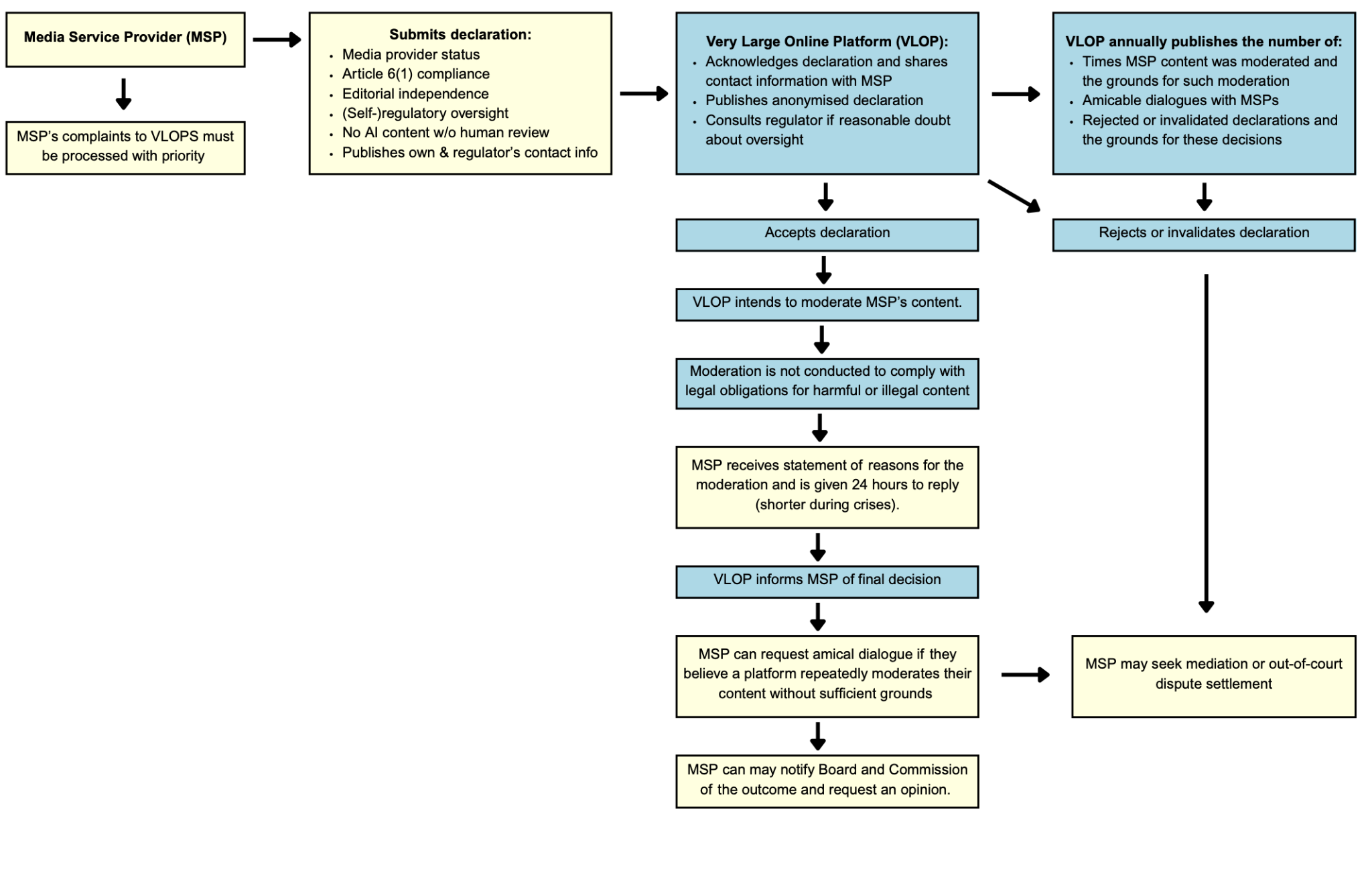
First, we offer a descriptive overview of Article 18’s procedural design, identifying the mechanisms through which the EMFA operationalises media privilege (schematically mapped in Figure 1). Second, we examine how these procedural mechanisms embed specific assumptions about platforms’ capacity and willingness to act as co-governance partners and how they may – even inadvertently – entrench platforms’ authority over journalistic legitimacy. Simply put, our approach allows us to interrogate what Article 18 prescribes and what kind of governance arrangement it envisages, as well as how its procedural logic interacts with the platform-press relationship.
To assess implementation empirically, we based our platform selection on a two-stage selection process and decided on the following: Facebook, Instagram, X, YouTube, LinkedIn, TikTok, and Pinterest. We first drew on the Reuters Institute Digital News Report 2025 (Newman et al., 2025, p. 15) as the basis for identifying the main social media platforms where news media organisations are actively present and through which audiences access news, subsequently supplementing this with LinkedIn and Pinterest on the grounds that media organisations and journalists maintain a presence on or through these services. This yielded the full set of Very Large Online Platforms (VLOPs) examined in this study (Table 1).
For each platform, we took the following steps to systematically search for the existence of self-declaration mechanisms. First, we performed targeted web searches using the query “[VLOP] European Media Freedom Act declaration form” queries on Google Search and one AI chatbot (Anthropic’s Claude) to increase the chances of identifying direct links to any declaration portals. Second, where we could not identify direct links, we visited the platforms’ dedicated regulation-related pages and searched for specific keywords (i.e., EMFA, (self-)declaration, etc.). Additionally, it is worth mentioning that the European Broadcasting Union (EBU) has been monitoring Article 18’s compliance and has published a list of VLOPs’ declaration portals, including pertinent information, that we used to corroborate our findings (Bergmann, 2026). The search took place between April and May 2026. Finally, we compiled all findings into Table 1, which contains key details for each platform’s compliance with Article 18: whether a declaration mechanism exists; its submission format and accessibility; the substantive criteria and information required from declaring MSPs; and any noteworthy additional requirements. This process helped us identify similarities and differences both among platforms and between what was requested or expected by the Commission and/or the Board and what the platforms had done.
| Declaration Requirement / VLOPs | YouTube | Meta (FB/IG) | X | TikTok | ||
|---|---|---|---|---|---|---|
| Implementation status | TRUE | TRUE | TRUE | TRUE | TRUE | TRUE |
| Disclosed reception of declarations | No | No | Has added a section but it is empty | No | Has added a section but it is empty | No |
| Declaration format & process | ||||||
| Submission method | Online form; one account at a time. | Online form (multiple accounts in one submission) | Google Form | Email submission of specific Word/PDF template to a designated address; multiple accounts can be listed. | Online form (multiple accounts in one submission) | Email submission with relevant information; separate email must be sent for each natural or legal person. |
| MSP eligibility criteria (Article 18(1)) | ||||||
| MSP status (Art. 18(1))(a) | Self-declaration | Self-declaration; must indicate type (TV, radio, AVMS, audio podcast, press, freelancer, professional actor) | Self-declaration; must indicate type (TV, radio, AVMS, audio podcast, press, freelancer, professional actor) | Self-declaration; must indicate whether they are PSM; describe professional activities (such as type of media service and topics covered) and provide link to relevant sites/channels | Self-declaration | Self-declaration |
| Ownership transparency (Art. 18(1)(b), (Art. 6(1))) | Self-declaration | Self-declaration | Self-declaration | Self-declaration that audience is provided with legal name, contact details, names of (beneficial) owners, amount of (third-country) public advertising revenue; links where this information is publicly available and confirmation it is up-to-date. | Self-declaration | Self-declaration |
| Editorial independence (Art. 18(1)(c)) | Self-declaration | Self-declaration | Self-declaration | Self-declaration; supporting evidence (such as editorial standards documentation or confirmation by a partner CSO) | Self-declaration | Self-declaration |
| Editorial responsibility & regulatory oversight (Art. 18(1)(d)) | Self-declaration | Self-declaration | Self-declaration | Self-declaration; supporting evidence; JTI transparency report or certificate if available | Self-declaration | Self-declaration |
| Human control over AI-generated content (Art. 18(1)(e)) | Self-declaration | Self-declaration | Self-declaration | Self-declaration; supporting evidence demonstrating AI content is subject to effective human oversight (e.g., a link to publicly available AI policy) | Self-declaration | Self-declaration |
| Information required from declarant | ||||||
| Name & contact details (Art. 18(1)(f)) | Legal name, email, phone (not mandatory), address, country (only EU Member States can be selected); channel name and ID | Public & legal name, address, country, phone number, email, website | Public name (optional), legal name, address, country, phone, email | TikTok verified badge required before submission; legal name, contact details; provision of unique identifiers associated with legal identity | legal name, email address | Legal name and contact details |
| Regulatory authority / body details (Art. 18(1)(g)) | Name, email, phone, address, country (only EU Member States can be selected) | Name, address, country (only EU Member states can be selected), URL, phone number, email, type (regulatory / self-regulatory / co-regulatory); MSPs must provide details for all authorities overseeing their editorial activities | Name, address, country, URL, phone, email, type (e.g., regulatory / self-regulatory / co-regulatory) | Name; address; email; link to website | Contact details | Contact details of the relevant national regulatory authority or co-/self-regulatory body |
| Submitter details | Name, confirmation they are authorised to declare on the MSP's behalf | Name, role, confirmation they are authorised to declare on the MSP's behalf, and company's name, phone number, and email. | Name, confirmation they are authorised to declare on the MSP's behalf | Name; position; personal email and a general email for the MSP; confirmation of authority to act on behalf of MSP | None required. | Implied in email sender details |
| Account / profile details | YouTube Channel name and ID | Link to all Facebook pages/profiles or Instagram accounts to be covered | X username | Email for primary TikTok account; user handle and link to profiles for all accounts to be covered | Pinterest username(s) | Not specified separately |
| Supporting documentation | Check-box confirmation the provided information is true; supporting information cannot be provided in the form | Supporting information cannot be provided in the form | Check-box confirmation the provided information is true, with warning of liability for false declarations. Supporting information cannot be provided in the form | Confirmation that the provided information is true to the best of the MSPs knowledge and incomplete/false/misleading infomration may lead to rejection/invalidation. Request to provide any additioal information the MSP deems to support the application and is relevant to TikTok's decision | Option to enter additional information to support the submission and upload documentation. | The email should include "supporting documentation, if applicable" |
| Declaration portal | ||||||
| Links | YouTube | Meta | X (Google Form) | TikTok | lera_ie@linkedin.com (email) | |
The European Media Freedom Act (EMFA)
In recent years, the EU has been at the forefront of technology governance, particularly seeking ways to address platform firms’ growing control over the information ecosystem. In April 2024, the EU adopted the EMFA, a regulation explicitly designed – among other objectives – to safeguard editorial content from potentially unjust platform moderation practices. Central to these efforts is Article 18 EMFA, which introduces procedural obligations for platforms with over 45 million monthly active users in the EU (i.e., VLOPs) when they moderate content of certain media organisations (i.e., MSPs).
Media privilege
Article 18 establishes a complex, multi-stage compliance regime. As illustrated in Figure 1, the mechanism operates mostly chronologically: it begins with a self-declaration process (top-left), proceeds to a conditional notification regime for moderation (centre) and concludes with various dispute settlement avenues (bottom-right). The following section details each of these procedural stages.
When platforms moderate MSPs’ content for violating their terms and conditions, the EMFA requires them to do two things. First, they must provide a Statement of Reasons (SoR) for this decision, as also required under Article 17 DSA and Article 4 P2B (Platform-to-Business) (Regulation 2019/1150) regulations. The SoR must explain what restriction was imposed, which terms of service were violated, and the facts and circumstances that led to a platform’s decision. Second, VLOPs must give MSPs 24 hours to respond before the restriction takes effect; this window can be shortened during crises, so long as it still allows MSPs sufficient time to respond to the decision. This is arguably the most consequential dimension of Article 18, as it effectively ensures MSPs content remains available for a limited amount of time. So, whereas the DSA and P2B regulation require the SoR to be provided concurrently with or following the decision, Article 18(4) EMFA requires this notification to be issued prior to the decision. Additionally, complaints submitted by MSPs through the internal complaint-handling systems established under Articles 20 DSA and 11 P2B regulation must be “processed and decided upon with priority and without undue delay” (Arts. 18(5) EMFA). The EMFA, therefore, strengthens the rights already provided to all (business) users under the DSA and P2B regulation, while introducing new obligations for platforms specifically tailored for MSPs, thereby creating a preferential treatment for media.
To be sure, these privileges only apply when content is moderated based on incompatibility with platforms’ terms and conditions. They do not apply to the removal of illegal content. This likely excludes content removed pursuant to public authority orders to remove illegal content under Art. 9 DSA, thus leaving MSPs without additional protection in precisely those cases where state and platform power converge. It also does not apply when platforms moderate lawful content pursuant to their obligations to protect minors, address hate speech, or mitigate systemic risks, which remain loosely defined (e.g., Art. 28b of the 2018 Audiovisual Media Services Directive; Arts. 28, 34, 35 DSA). Depending on interpretation, platforms could still moderate public interest journalism deemed harmful to minors, such as the ‘Napalm girl’ photo.
Further, the EMFA introduces numerous dialogues and dispute settlement procedures specifically for MSPs. First, platforms must engage in a dialogue with media organisations that consider their content to have been repeatedly restricted or suspended without sufficient grounds. This dialogue must be meaningful, effective, and aim to find an amicable solution to avoid future unjustified restrictions (Art. 18(6) EMFA). The media organisation may notify the Commission and the European Board for Media Services (the Board – consisting of national media regulators) of the dialogue and the Board may provide an opinion on it (Art. 18(6) EMFA).
Second, if no amicable solution is found, or a platform rejects or invalidates a media organisation’s application for the media privilege, that MSP may resort to mediation and out-of-court dispute settlement procedures set out by the DSA and P2B regulations (Art. 18(7) EMFA). Neither procedure can result in a binding settlement being imposed on platforms (Rec. 40 P2B; Art. 21(2) DSA). However, MSPs can again notify the Board of the outcome and are free to go to court after the DSA and P2B dispute settlement procedures (Recital 59 DSA, Art. 12(5) P2B regulation).
Third, the EMFA requires platforms to handle complaints that media organisations submit through their internal complaint-handling systems (Art. 11 P2B Regulation and Art. 20 DSA), with priority and without undue delay (Art. 18(5) EMFA). Fourth, the EMFA requires the Board to organise a regular ‘structured dialogue’ between platforms, media organisations and representatives of civil society on assessing the application of the media privilege, the accessibility of diverse and independent media content on platforms and platforms’ adherence to self-regulation against harmful content such as disinformation (Art. 19 EMFA), though it does not impose any obligation on platforms to give effect to this dialogue.
Finally, similar to DSA Article 15, Article 18(8) EMFA requires VLOPs to publish annual transparency reports but specifically regarding MSP-related incidents, such as the number of restrictions imposed on MSPs, the contractual grounds invoked to justify those restrictions, the number of dialogues initiated, and the number of declarations rejected or invalidated. It must be noted, though, that the coordination of the regulatory bodies (e.g., EMFA’s Board and DSA’s European Board for Digital Services) responsible for monitoring and enforcing the various, often overlapping, regulatory obligations is not formally planned, which might lead to parallel transparency or procedural processes. Additionally, it is not entirely clear how national regulators comprising the Board will be properly equipped to handle their tasks, provided that they are not materially empowered in the same way that the Commission and relevant stakeholders are owing to, among others, the DSA-mandated platforms’ annual supervisory fee; the only relevant reference in the EMFA states that “Member States shall ensure that the national regulatory authorities or bodies have adequate financial, human and technical resources to carry out their tasks under this Regulation” (Art. 7(3)). As a result, there might be a hierarchisation of tasks by national regulatory authorities relative to their capacity, which might hinder the proper implementation, monitoring, and evaluation of the regulation.
Whom does it concern?
To qualify for the media privilege, media organisations must submit a self-declaration to platforms. In this application, they must declare that they inter alia exercise editorial control, are editorially independent from states and political parties, do not produce content using generative AI systems without human supervision and are subject to media law or widely accepted self-regulatory mechanisms governing editorial standards. The boundaries of these norms are vague. For example, does an influencer exercise editorial control if they have no control over the way platforms distribute their content (Duffy & Meisner, 2023)? Under what conditions is the editorial independence of public service media sufficiently safeguarded? How these questions are answered determines which actors are given privileges and which are not (cf. Verza, 2025)
Platforms are primarily responsible for determining whether media organisations meet the EMFA’s criteria for the media privilege. They can reject or invalidate a media organisation’s application when they consider that organization does not meet the EMFA’s criteria (anymore) (Rec. 53, Art. 18(7) EMFA). In one instance, platforms are required to involve another actor in this decision: they must reach out to national regulators when they have reasonable doubts concerning a media organisation’s compliance with the editorial responsibility framework. In addition, the EMFA notes that platforms may rely on self-regulatory standards, such as the Reporters Sans Frontières’ (RSF) Journalism Trust Initiative (JTI), to assess whether media organisations meet the EMFA’s responsibility requirements.
Media organisations can contest platforms’ rejection or invalidation of their application through the mediation and out-of-court dispute settlement procedures set up by the P2B Regulation and DSA. However, there is no formal mechanism for other actors like civil society organisations (CSOs) to contest the way in which platforms handle MSP’s declarations, including false positives, where a platform wrongfully accepts a declaration of an MSP (for example, a state-affiliated media organisation claiming to be editorially independent). Recital 53 EMFA seems to offer a limited remedy, as it suggests that “recognised civil society organisations, fact-checking organisations and other relevant professional organisations” may flag concerns to platforms regarding MSP’s compliance with the self-declaration criteria. Yet, it does not require platforms to react to such flags or provide any avenues for challenging platform decisions. Similarly, Meta’s first EMFA transparency report indicates that it considers some self-declarations by MSPs to fall outside the scope of Art. 18. Specifically, declarations by “non-media service entities located outside of the EU” that “did not provide the information required by Article 18(1)” (Meta, 2026, p. 2). These applications were not included in the rejection or invalidation statistics and, presumably, would not be able to make use of the contestation mechanisms for rejected or invalidated declarations.
Finally, the EMFA provides limited transparency needed for public scrutiny of who is afforded the media privilege. It requires the number and grounds for rejections and invalidations to be published, as well as the media organisation’s applications, though without their name and contact details (Art. 18(2) EMFA). Further, the EMFA requires platforms to disclose the number of instances and specific grounds on which they have removed MSPs’ content (Art. 18(8)(a-b) EMFA).
Operationalisation
The Commission has recently adopted guidelines that indicate how platforms should operationalise media privileges (European Commission, 2026). The guidelines note platforms should provide pre-compiled checkboxes that allow media to self declare they comply with Article 18(1)(a-e) EMFA and provide the contact details required under Art. 18(1)(f-g). All platforms provide this option. The guidelines also note that VLOPs should give MSPs the option to provide further information (para. 17), for example, regarding their independence (paras. 23-26) or their generative AI content review practices (paras. 38-41). Only TikTok and LinkedIn allow for this in their forms, though it is not clear whether providing such information is indeed optional. This speaks to a broader issue, namely that, while the guidelines set out more explicitly what information is relevant to assessing MSPs’ compliance, it remains unclear if and how compliance with these criteria is verified.
The guidelines essentially establish two paths. First, they note that platforms may verify compliance, including based on publicly available information, such as ownership databases or national regulatory authorities’ registries of the MSPs they oversee (paras. 23-26). Second, the guidelines note that (co/self-)regulatory authorities and CSOs may flag MSPs’ noncompliance on any criteria to platforms; if CSOs flag noncompliance, platforms should seek confirmation from the relevant (co/self-)regulatory authorities (para. 46). The guidelines further note platforms should establish points of contact for such flagging and publish a list of partner CSOs (para 58, 59).
The bulk of these verification mechanisms, however, appears to be voluntary (see for an exception para. 45, which implies platforms must verify MSPs’ compliance with (co/self-)regulation based on publicly available information). The voluntary nature of the verification mechanisms creates a risk that platforms operationalise them in a way that minimises their economic costs – doing as little verification work as possible and ignoring or (arguably worse) indiscriminately accepting flags from CSOs and/or authorities that strip media organisations of their protection. A related risk is that platforms operationalise verification in a way that serves their political and economic interests, applying little verification to uncontroversial or mainstream media, while scrutinising applications from those whose political interests are not necessarily aligned with platforms or regulatory authorities, which may exert pressure on platforms.
More fundamentally, the verification mechanism is designed to minimise abuse of the privileges. This is evident in both the focus on enabling the flagging of noncompliant media, as well as the guidelines’ framing of CSOs role as combatting foreign information manipulation and interference (para. 56). There is, however, little attention for the need to identify false negatives. This burden is placed exclusively on the MSPs whose application is rejected. While this may be a suitable remedy for some MSPs – and indeed the EMFA allows rejected MSPs to contest and be represented in this procedure –, it does little to ensure the overall system is accessible to a wide variety of media.
Finally, the guidelines make several recommendations related to ease-of-use. Platforms have generally not adopted these. Forms are generally available only in English (para. 14), hard to find (paras. 3, 13), not standardised (para. 14), and only TikTok, Meta, and Pinterest allow multiple accounts to be declared in a single submission (para. 15). As noted in the guidelines and the Board’s position paper (European Board for Media Services, 2025), this may make it challenging for smaller, local, or non-English-speaking media to make use of the EMFA’s protection (see also Bergmann, 2026). This risk is further exacerbated by the discretion of VLOPs in asking for further documentation from MSPs. To illustrate, both the Board’s opinion (2025, p. 3) and the Commission’s guidelines (2026, paras. 17, 32) emphasised the optional nature of providing further supporting evidence but, for instance, TikTok explicitly requires MSPs to have a “verified badge” and requests information about the applicants’ participation in the JTI scheme and their AI policy; see Table 1).
Discussion
The EMFA addresses platforms’ discretionary power over editorial content through procedural safeguards, particularly by mandating notification requirements and redress mechanisms before moderation decisions are executed. However, this ostensibly protective framework is paradoxically reliant on platform firms themselves, raising several fundamental issues that we discuss in the next sections.
Institutionalising platforms’ control over journalistic legitimacy
First, the media privilege granted through the EMFA risks structurally embedding platform firms as adjudicators of news legitimacy. Media privileges are ultimately based on a simple logic: because media organisations fulfil an important role in democratic society by providing high-quality independent information, they should be afforded certain protections so they can better serve the public interest (Monti, 2024; van Drunen, 2025). The EMFA primarily relies on platforms to decide which media organisations live up to their end of the bargain and deserve the extra protection states afford them against platform moderation. However, it does so while affording platforms the sole power to strip media of protection by invalidating their application when they deem media organisations to no longer meet the criteria for the media privilege.
By way of illustration, we might imagine X verifying whether an MSP is editorially independent (Art. 18(1)(c)), exercises sufficient control over generative AI (Art. 18(1)(e)), or adheres to ‘widely accepted’ standards (Art. 18(1)(d)). These are highly normative questions that directly touch on the legitimacy of media organisations. Their sensitivity can be seen in practice in the controversies surrounding platforms’ existing efforts to label media, such as when X labelled NPR as a ‘state-affiliated media’, ignoring or overlooking the fact that NPR is a private, nonprofit company with less than 1% of its annual budget coming from federal funds (Folkenflik, 2023). Such examples illustrate the normative and democratic stakes involved when platforms are left to (or even called upon) make politically charged decisions.
Even where platforms make these decisions in a less controversial way than X did in the above example, the mere fact that they have a formal role to decide which media organisations are and are not deserving of privileges is a fundamental shift. Instead of states and media organisations deciding which media deserve privileges through courts or self-regulatory journalistic ethics bodies, the EMFA structurally embeds platform firms as the initial adjudicators of news legitimacy. This outcome risks strengthening platforms’ institutional standing within the EU’s technology and media governance framework and affords them a new, legally legitimated power over the media.
Discretion
Second, the EMFA grants platforms considerable discretion throughout the operationalisation of the media privilege. The norms media organisations must comply with to qualify for the media privilege, particularly regarding their editorial independence, responsibility, and control over generative AI content, are open to many interpretations (Barata, 2022; van Drunen et al., 2023). Additionally, platforms’ obligation to involve other actors in reviewing MSPs’ declarations is framed in an open manner: platforms ‘should’ rely on standards such as the JTI and enable CSOs to flag compliance issues but are under no obligation to do so. In slightly stronger terms, the EMFA states a platform must ‘seek confirmation […] from the relevant regulatory authority’ regarding MSPs’ compliance with editorial responsibility frameworks, but only if the platform has ‘reasonable doubts’ (Art. 18(1)). Finally, even if MSPs qualify for the media privilege, platforms may argue it does not apply to moderation decisions they take under their broad obligation to mitigate systemic risks.
The problem here does not lie in the open-ended norms themselves. Abstract norms are unavoidable – there is a limit to the specificity with which laws can be written and Article 18 is already the longest provision in the EMFA. The problem lies in the fact that Article 18 relies heavily on platforms to operationalise these norms. This issue is exacerbated by the EMFA’s weak enforcement structure. There are, in theory, two main ways to contest platforms’ operationalisation of Article 18. First, MSPs may use the non-binding procedures the EMFA foresees, including mediation/out-of-court dispute settlement (Art. 18(7) EMFA; Art. 21(2) DSA), without prejudice to litigation (Art. 21(1) DSA). Second, although Article 18 EMFA does not itself empower public authorities to impose sanctions, they may intervene where a platform’s conduct independently breaches national or EU laws like the DSA. The first way could help lower barriers for smaller or resource-constrained media organisations as they may be represented by certified relevant bodies free of charge or for a nominal fee in these procedures (Art. 21(5) DSA), while the second could help address overlapping systemic risks regarding platforms’ moderation practices, especially related to media pluralism (Art. 34(1)(b) DSA).
However, the EMFA fails to give the national regulators, which are expected to enforce the media privilege against platforms, clear sanctioning powers. It instead relies on member states to ensure they have the necessary regulatory capacity to enforce the EMFA (Art. 7 EMFA) and on the Commission’s non-binding guidelines on the operationalisation of Article 18 EMFA (European Commission, 2026). This approach contrasts with that of the DSA and DMA, which centralise enforcement power in the hands of the Commission, giving it the power to impose heavy fines and requiring platforms to pay supervisory fees to ensure its regulatory capacity. We do not argue that this structure can simply be copied to the EMFA. First, interventions in the space of media regulation have always been “politically sensitive” (Cantero Gamito, 2023, p. 2), and enforcing the media privilege requires assessing highly complex and normative questions (Seipp et al., 2023), such as “editorial independence” and adherence to professional journalistic standards, which are “extremely difficult to assess” and contextual-bound (Kuczerawy & Quintais, 2026, p. 78). For this reason, the EMFA relies on a more decentralised structure involving national regulatory authorities, self- and co-regulatory bodies, and the Board. As a result, the different approach for Article 18 EMFA may be understandable, but it also creates an enforcement gap, especially given the resource asymmetries between both platforms and regulators, as well as among governance stakeholders (Papaevangelou et al., 2026).
Affording platforms such discretion in operationalising the media privilege while failing to guarantee strong oversight over how they do so is dangerous. First, as other researchers working on the EMFA have noted, such privileges can be exploited by “media service providers that actively spread disinformation or serve as propaganda channels for authoritarian governments” (Kuczerawy & Quintais, 2026, p. 95; see also Horton & Assersen-Skadberg, 2026; Monti, 2024). Subsequently, as further substantiated in the theoretical framework, platforms’ economic and political interests in the news media are fundamentally at odds with the values underpinning the media privilege, like editorial autonomy and media pluralism. As such, the EMFA creates a situation wherein the media privilege may be leveraged by platforms to further their own political and economic interests, for instance, by selectively offering protection to media that align with their commercial incentives (e.g., higher algorithmic engagement potential) with clear political implications (e.g., exacerbation of media inequalities or underrepresentation of marginalised communities). These risks are well known in literature on media privileges (Tambini, 2021b) and critical political economy of media (e.g., Freedman, 2015), yet the EMFA creates few safeguards to mitigate them.
Some safeguards, such as the need for independent actors to apply the media privilege, are unavailable simply due to the choice to rely on platforms to operationalise the media privilege. Others, however, are simply weakly formulated or absent. In particular, the transparency needed to scrutinise how platforms apply the media privilege is lacking. Platforms only have a general obligation to publish the number of instances and grounds for which it rejected/invalidated MSPs’ declarations. Platforms are explicitly not required to publish the names of MSPs that have submitted a declaration (Art. 18(2) EMFA), nor are they required to provide any ex-ante justification for their decision to accept/reject/invalidate an MSPs declaration. While this may serve to protect media organisations’ privacy, it imposes significant constraints on the public’s ability to scrutinise how platforms exercise their discretion to determine which media are legitimate enough to qualify for the media privilege.
The most useful safeguards are not formulated explicitly in the EMFA. First, Article 40 DSA requires platforms to grant researchers access to data necessary to scrutinise, inter alia, risks to media freedom. As the EMFA frames platform moderation as a media freedom issue, researchers may be able to use Article 40 DSA to get access to data that allows them to understand which media benefit from the media privilege and which do not and if platforms apply the media privilege in a consistent way. Second, as the Council of Europe has emphasised, the decision to qualify for a media privilege should ultimately rest with courts (2021, p. 7). Media associations may therefore collectively support one another to ensure a media organisation facing platform retaliation has the resources to have a court adjudicate their claim; though, the existing power asymmetries within the news industry are not always conducive to collective action.
Role of civil society and media
The EMFA encourages platforms to involve other actors when it decides which MSPs qualify. Specifically, platforms may rely on self-regulatory standard-setting initiatives such as the JTI initiatives to determine whether media organisations meet the EMFA’s criteria and on CSOs and fact checkers that flag media organisations that no longer meet the criteria. However, platforms’ reliance on these actors is entirely voluntary and their positive influence on the operationalisation of the media privilege is precarious. As Meta’s rollback of third-party fact checking in early 2025 shows (Hendrix, 2025), platform support for these initiatives – and with that civil society’s investments in becoming a stable long-term partner – can be taken away as soon as it is politically or economically advantageous for platforms to do so. Moreover, the voluntary nature of platforms’ reliance on civil society creates a dangerous power imbalance if protection from platform moderation becomes an important benefit associated with media organisations going through the JTI certification process.
Further, platforms’ reliance on standards such as the JTI simply shifts control over who qualifies for the media privilege one level down, namely to the body (or bodies) that set and certify media’s compliance with those standards. The role of bodies like the JTI also requires scrutiny as self-certification is often perceived as sufficient, while external validation relies on third-party auditors, including big consultancy firms like Deloitte, which are heavily involved in auditing processes under the DSA (cf. Terzis et al., 2024). Consequently, the EMFA’s procedural reliance on such self-regulatory mechanisms risks, perhaps inadvertently, further entrenching – in addition to platforms’ power – the authority of general-purpose auditing corporations under the guise of procedural fairness, rather than supporting more journalism-oriented and accountable governance processes.
Proceduralism and power
Fourth, the EMFA takes a procedural approach that relies on voluntary dialogues, internal complaint mechanisms and out-of-court mediation. This design represents a clear departure from the ‘non-interference principle’ that the press lobby unsuccessfully advocated for during the DSA negotiations (Papaevangelou, 2023); instead of a more horizontal and rather substantive approach that mainly media actors sought in the DSA, the Commission settled for a procedural-based co-regulatory compromise in the EMFA. Moreover, it seems that such reliance on platforms’ internal governance structures is endemic to the EU’s approach to tech regulation, arguing it fundamentally undermines its own objectives. We find that the EMFA’s procedural approach to regulating the relationship between news media and platforms is unlikely to meaningfully redress the structural inequalities and power asymmetries between journalism and profit-driven tech firms.
A primary reason for this limitation is that the EMFA, much like other recent EU regulatory efforts, places excessive trust in norms of multi-stakeholderism and procedural fairness. This trust speaks to an assumption that platforms will act as reliable co-governance stakeholders and that more and/or better procedures will ‘democratise’ platforms. This assumption, however, has been difficult to sustain, especially in the light of platforms’ continued conduct. By way of illustration, reporting on Meta’s so-called ‘XCheck’ programme revealed how the company publicly presented moderation rules as generally applicable while ‘whitelisting’ (i.e., internally granting special treatment) to high-profile users (cf. Horwitz, 2021). More gravely, investigations into platform governance in Myanmar (Amnesty International, 2022) and Palestine (cf. HRW, 2023; Mazurov & Valdez, 2025) have documented how Meta and Google have failed to prevent, and in some cases contributed to, serious human rights harms through under- or over-enforcement of moderation rules. More recently, the Commission published preliminary findings claiming that Meta breached the DSA for failing to prevent minors under 13 years old from using Instagram and Facebook despite the company’s own terms and conditions1. As a result, it is hard to reconcile the expectation that these companies will fall in line with their track record.
Further, the problems with the EMFA’s procedural logic are particularly evident where the EMFA’s procedures are weakest, namely where it requires platforms to “engage in a meaningful and effective dialogue ... in good faith with a view to finding an amicable solution” (Art. 18(6) EMFA) to repeatedly potentially unjustified content moderation with the affected MSP. Arguably, the regulatory process envisioned aims to compel platforms to mitigate chilling effects on media freedom that result from unjustified removal, demotion, or demonetisation. However, requiring platforms to act in good faith does not mean they will comply. On the contrary, we have plenty of examples showing that the opposite is more likely: from their opaque governance (see e.g., Leerssen’s (2023) account of “shadow banning”) to their constant repositioning in relation to the news media industry that was discussed earlier, there is significant reason to doubt their good faith in such dialogues.
Still, if the dialogue is not carried out in good faith, Article 18 EMFA does not offer a clear remedy beyond the existing non-binding options for out-of-court dispute settlement. Therefore, Article 18 does not eliminate the intrinsic risks associated with platform content governance. Instead, it relocates these risks to the procedural sphere, where platforms retain substantial interpretive discretion, while CSOs or regulatory authorities, that is actors capable of challenging these power asymmetries, are largely excluded from initial decision-making.
Further, some critics caution that Article 18 EMFA could inadvertently deepen existing inequalities between media organisations (Seipp et al., 2024). Concretely, the media organisations with the resources to participate in the procedures the EMFA sets up are not likely to be the marginalised, smaller media outlets most in need of the protection the EMFA offers. Similarly, while the EMFA’s provisions to foster ‘structured dialogues’ (Art. 19) among platforms, MSPs, and civil society could be instructive for future governance approaches, that ambition can only materialise through the meaningful participation of marginalised communities and under-resourced stakeholders, which undoubtedly necessitates making additional resources and expertise available, as well as devising truly inclusive policymaking strategies.
Where do we go from here
In this article, we tried to discuss Article 18 EMFA’s intricacies. We contend that its complexities should not obscure that it, ultimately, does little to address the broader imbalances between platforms and the press (Kuczerawy & Quintais, 2026) as it largely leaves platforms free to moderate media content if they follow the established procedures. As Verza put it: “the ‘media privilege’ is in practice not more than a fair procedure [and] [...] hardly more than a symbolic gesture to [MSPs]” (2025, p. 14). Although the EMFA’s positive-rights framework is a welcome recognition of journalism’s democratic and societal value (Tambini, 2021a) it remains fundamentally narrowed by the EU’s market-oriented approach to platform governance (Griffin, 2023) and by a form of multi-stakeholderism that appears increasingly limited for constraining the multifaceted power of platform firms, especially at a time of profound convergence with state (geo)political power and interests (Rolf & Schindler, 2023; Leerssen, 2025). Instead of dismantling platforms’ gatekeeping role or, at least mitigating their power as regards the discretionary control they exercise on journalistic information, the EMFA may inadvertently reinforce a scenario wherein media organisations must continually negotiate their legitimacy within corporate governance frameworks with little democratic oversight and accountability. Thus, the core issue is less about whether EMFA alone can resolve journalism’s systemic challenges – which it clearly cannot and was not even intending to – but rather whether it unintentionally reinforces platform dominance through a form of procedural dependency, limiting possibilities for greater structural regulatory transformations, and creating problematic path dependencies for future media privileges. In that context, it is vital not to judge the EMFA in terms of what is politically feasible given platforms’ broader political, economic, and infrastructural power, but by what is necessary to safeguard media freedom. The risk of a poorly designed media privilege is not that the EMFA fails to protect media, but that it institutionalises platforms’ power over journalistic legitimacy, opens up space for weaponisation of the media privilege, and strengthens inequalities in the media system. In this light, it is critical that the EMFA does not draw our attention away from the need for structural reforms.
A full exploration of what such reforms would look like goes beyond the scope of this paper, but we see two main interlinked policy paths ahead, both of which need to start by acknowledging that safeguarding media freedom can come at an economic and political cost to platforms. Consider, for instance, the slots in users’ feeds as valuable real estate. Any slot a platform is forced to reserve for news content, e.g., depicting the consequences for Palestinian lives amidst what a UN enquiry has described as a genocide in Gaza (UNHRC, 2025), is a slot that cannot be used for more engaging content to keep users scrolling through advertisements, or to advance the political interests of their owner(s).
First, rather than asking platforms to ignore these costs, reforms should aim to insulate platforms’ power to decide on news content’s visibility from platforms’ economic and political interests as much as possible. Measures toward that path could involve imposing binding “must-carry” principles (Radsch & Schiffrin, 2025) that impose substantive rather than procedural limits on the way platforms treat news. While such provisions can mitigate platform dominance and prevent arbitrary censorship, they are not a silver bullet: as recent scholarship warns (Dutkiewicz & Kuczerawy, 2025; Kuczerawy & Quintais, 2026; Schiffrin et al., 2025), these proposals often function less as neutral distribution mandates and more as “special treatment” rules that risk entrenching the power of legacy media.
The second path operates at a more structural level, departing from the recognition that, oftentimes, policy reforms leave the underlying political economy of capitalism unaddressed. As a result, reformist attempts aiming to improve platforms’ conduct have encountered considerable obstacles. Turning to scholarship on critical political economy of media (e.g., Freedman, 2022; Pickard, 2023), we are reminded that addressing challenges to media freedom requires creating the market structures that allow media organisations to shed their dependence on platforms. Proposals from this strand range from equitable public subsidies for media and cooperative ownership models to publicly governed infrastructures. In other words, such proposals propel us to undertake structural reforms that redistribute power and resources in the information ecosystem with a view to reducing dependence on private for-profit platforms. Such reforms would better support forms of journalism that are more aligned with holding power to account and serving democratic needs, instead of protecting the status quo. In that sense, all reforms should prioritise smaller news outlets, local and independent in particular, as they are more-often-than-not the ones suffering from both inter- and intra-sectorial power asymmetries while conducting some of the most impactful and meaningful journalism.
Conclusion
This article, following an analysis of how Article 18 EMFA is being implemented to regulate moderation of editorial content, has sought to foreground its inherent paradox, namely that Article 18’s operationalisation hinges upon platforms. Drawing upon various legal and policy documents, including the EMFA and the Commission’s Article 18 guidelines, the Board’s position paper, platforms’ own transparency reports and compliance portals, we conclude that Article 18 takes a crucial step in recognising the need for states to take active measures to protect media freedom from platforms. However, the regulation’s dependence on platform-operated procedural mechanisms significantly constrains its potential for structural change, risking instead legitimising platforms as gatekeepers and adjudicators of journalism’s legitimacy. This must not be underestimated as procedures matter (Tambini, 2021a).
The EMFA’s approach thus exemplifies broader governance trends, particularly in the EU, characterised by excessive reliance on multi-stakeholder processes and procedural fairness, failing to adequately consider platforms through a materialist lens (cf. Sadowski, 2025) as rational and profit-driven political actors (see Bietti, 2023; Terzis et al., 2026). The main consequence of this blind spot, or political unwillingness, is that the governance of our public sphere becomes procedurally dependent on platforms which inherently do not have a material interest in maintaining a high-quality, public-values-driven information environment. As a result, without trying to address the underlying structural cause that has enabled platform firms to amass such power, procedural reforms like those in the EMFA – regardless of their good intentions – will remain limited.
To better address journalism’s challenges in relation to platform power, regulatory efforts must go beyond procedural fixes to rethink journalism’s value as a societal good, laying the groundwork for reforms that reduce dependence on market forces and platforms altogether. This agenda would, among others, require publicly funded alternatives to platform-reliant models and stronger support for nonprofit and independent journalism. Currently, the EMFA’s procedural reliance on platforms risks amplifying existing inequalities within Europe’s media ecosystem, characterised by significant levels of concentration (cf. Blagojev et al., 2025), such as the burgeoning phenomenon of “news deserts” (Verza et al., 2024) or the unequal treatment of large and established media actors and smaller, independent ones by platforms regarding content licensing deals (cf. Blagojev et al., 2025, p. 59). As a result, policymakers and stakeholders should be alert to the risk that media privilege may exacerbate existing disparities, further undermining smaller, non-profit, or independent media organisations in particular (Seipp et al., 2024).
Our analysis has various limitations. First, given that the EMFA only entered into application in August 2025, our findings represent but a snapshot of an early and still-evolving compliance landscape, explicitly focusing on how platforms have been operationalising Article 18. Second, our capacity to collect more data and information, especially regarding the legislative process that led up to the adopted version of Article 18, including the Commission’s recent recommendations, was hindered by a relative lack of transparency. We submitted two Freedom of Information (FOI) requests via the AskTheEU platform to access minutes a) from the Commission’s meeting on 19 January 2025 with platform representatives regarding Article 18(9)’s implementation2, and b) from the Commission’s meetings with platform representatives and the RSF in the years leading up to the EMFA’s proposal (2021-2023)3. Both requests were partially rejected as the documents were vastly redacted on the grounds that disclosure would reveal “sensitive information with regard to ongoing procedures” and internal deliberations. Finally, at the time of writing, only Meta (2026) has published statistics on which MSPs have successfully applied for the media privilege, which are RAI (Italy), ZDF (Germany), RTBF (Belgium), and Yleisradio Oy (Finland).
Future research should empirically analyse the EMFA’s implementation and operation across EU member states, including which media organisations have obtained the media privilege examined in this paper and whether they materially benefit from it, as well as how platforms handle their declarations. Future work should also focus on the participation in and outcomes of the structured dialogues to gauge their effectiveness and representativeness. We believe that our study offers actionable insights to involved policymakers and stakeholders which will be called to evaluate the EMFA’s performance and hope that our critique will advise them on rethinking their strategy vis-à-vis platforms’ role but also a more just information environment.
References
Agarwal, S. (2025). Rooting platform dependencies in the Digital News Economy: Google News initiative in India. International Journal of Communication, 19, 135–158.
Amnesty International. (2022, September 29). Myanmar: Facebook’s systems promoted violence against Rohingya; Meta owes reparations. Amnesty International. https://www.amnesty.org/en/latest/news/2022/09/myanmar-facebooks-systems-promoted-violence-against-rohingya-meta-owes-reparations-new-report/
Appelman, N. (2025). Contesting online exclusion. Universiteit van Amsterdam.
Barata, J. (2022). Protecting media content on social media platforms. Verfassungsblog. https://doi.org/10.17176/20221125-121603-0
Bastian, M., Helberger, N., & Makhortykh, M. (2021). Safeguarding the journalistic DNA: Attitudes towards the role of professional values in algorithmic news recommender designs. Digital Journalism, 9(6), 835–863. https://doi.org/10.1080/21670811.2021.1912622
Bergmann, T. (2026, March 10). Lost and found: Helping media outlets navigate Big Tech’s self-declaration maze. EBU. https://www.ebu.ch/news/2026/03/lost-and-found-helping-media-outlets-navigate-big-tech-s-self-declaration-maze
Bietti, E. (2023). A genealogy of digital platform regulation. Georgetown Law Technology Review, 7(1). https://doi.org/10.2139/ssrn.3859487
Board. (2025, July). Media Board’s position paper on the European Commission’s public consultation on Article 18 of the European Media FreedomAct (EMFA). Media Board. https://media-board.europa.eu/document/download/020e0aef-e8f5-44b9-b8ef-e48da0705f5f_en?filename=Position%20of%20the%20Media%20Board%20on%20the%20consultation%20on%20Article%2018%20of%20the%20EMFA.pdf
Bossio, D., Carson, A., & Meese, J. (2025). A different playbook for the same outcome? Examining Google’s and Meta’s strategic responses to Australia’s news media bargaining code. New Media & Society, 27(7), 3890–3910. https://doi.org/10.1177/14614448241232296
Brown, P., & Jaźwińska, K. (2025). Journalism Zero: How platforms and publishers are navigating AI. Tow Center for Digital Journalism. https://towcenter.columbia.edu/sites/towcenter.columbia.edu/files/content/Journalism%20Zero_%20How%20Platforms%20and%20Publishers%20are%20Navigating%20AI_0.pdf
Cantero Gamito, M. (2023). The European Media Freedom Act (EMFA) as meta-regulation. Computer Law & Security Review, 48, 105799. https://doi.org/10.1016/j.clsr.2023.105799
Caplan, R. (2023). Networked platform governance: The construction of the democratic platform. International Journal of Communication, 17, 3451–3472.
Caplan, R., & Boyd, D. (2018). Isomorphism through algorithms: Institutional dependencies in the case of Facebook. Big Data & Society, 5(1), 205395171875725. https://doi.org/10.1177/2053951718757253
Caplan, R., & Gillespie, T. (2020). Tiered governance and demonetization: The shifting terms of labor and compensation in the platform economy. Social Media + Society, 6(2). https://doi.org/10.1177/2056305120936636
Crain, M. (2021). Profit over privacy: How surveillance advertising conquered the internet. University of Minnesota Press. https://doi.org/10.5749/j.ctv20zbktm
DeVito, M. A. (2017). From editors to algorithms: A values-based approach to understanding story selection in the Facebook news feed. Digital Journalism, 5(6), 753–773. https://doi.org/10.1080/21670811.2016.1178592
Directive (EU) 2018/1808 of the European Parliament and of the Council of 14 November 2018 Amending Directive 2010/13/EU on the Coordination of Certain Provisions Laid down by Law, Regulation or Administrative Action in Member States Concerning the Provision of Audiovisual Media Services (Audiovisual Media Services Directive) in View of Changing Market Realities, EP, CONSIL, 303 OJ L 69 (2018). https://eur-lex.europa.eu/eli/dir/2018/1808/oj
Dodds, T., De Vreese, C., Helberger, N., Resendez, V., & Seipp, T. (2023). Popularity-driven metrics: Audience analytics and shifting opinion power to digital platforms. Journalism Studies, 24(3), 403–421. https://doi.org/10.1080/1461670X.2023.2167104
Duffy, B. E., & Meisner, C. (2023). Platform governance at the margins: Social media creators’ experiences with algorithmic (in)visibility. Media, Culture & Society, 45(2), 285–304. https://doi.org/10.1177/01634437221111923
Dutkiewicz, L., & Kuczerawy, A. (2025). Protecting media content on social media platforms in the EU. In K. Barker & O. Jurasz, Routledge Handbook of Social Media, Law and Society (1st edn, pp. 163–183). Routledge. https://doi.org/10.4324/9781003252740-18
EBU. (2021, September 27). EBU welcomes important amendment to the Digital Services Act. https://www.ebu.ch/news/2021/09/ebu-welcomes-important-amendment-to-the-digital-services-act
Eichler, H. (2023). Cross-media and platformised journalism: ARD’s innovation attempts at becoming a multi-platform contributor to society. In M. Puppis & C. Ali (Eds), Public service media’s contribution to society: RIPE@2021 (pp. 265–288). Nordicom, University of Gothenburg. https://doi.org/10.48335/9789188855756-13
European Commission. (2022). The strengthened code of practice on disinformation 2022. European Commission.
European Commission. (2026, February 6). Commission issues guidelines to protect media content on online platforms. European Commission | Shaping Europe’s Digital Future. https://digital-strategy.ec.europa.eu/en/news/commission-issues-guidelines-protect-media-content-online-platforms
European University Institute. (2025). Monitoring media pluralism in the European Union: Results of the MPM2025. Publications Office. https://doi.org/10.2870/2415644
Facebook. (2020, September 8). Facebook response to EC public consultation on the Digital Services Act. Facebook. https://about.fb.com/de/wp-content/uploads/sites/10/2020/09/FINAL-FB-Response-to-DSA-Consultations.pdf
Ferrari Braun, A. (2026). “Reliable and cheap”?: Examining the adoption of the cloud by European news media companies. Media, Culture & Society, 01634437261442045. https://doi.org/10.1177/01634437261442045
Folkenflik, D. (2023, April 12). NPR quits Twitter after being falsely labeled as ‘state-affiliated media’. NPR. https://www.npr.org/2023/04/12/1169269161/npr-leaves-twitter-government-funded-media-label
Freedman, D. (2015). How to study ownership and regulation. In M. Alvarado, T. Miller, & M. Buonanno (Eds), The Sage Handbook of Television Studies (pp. 3–21). Sage.
Freedman, D. (2022). Reverse media policy. In J. Pedro-Carañana, E. Herrera-Huérfano, & J. Ochoa Almanza, Communicative Justice in the Pluriverse (1st edn, pp. 94–108). Routledge. https://doi.org/10.4324/9781003316220-7
Google. (2025). Report of systemic risk assessments (No. 2024). Google Ireland Limited.
Gorwa, R. (2019). The platform governance triangle: Conceptualising the informal regulation of online content. Internet Policy Review, 8(2), 22. https://doi.org/10.14763/2019.2.1407
Gorwa, R., Lechowski, G., & Schneiß, D. (2024). Platform lobbying: Policy influence strategies and the EU’s Digital Services Act. Internet Policy Review, 13(2). https://doi.org/10.14763/2024.2.1782
Griffin, R. (2023). Public and private power in social media governance: Multistakeholderism, the rule of law and democratic accountability. Transnational Legal Theory, 1–44. https://doi.org/10.1080/20414005.2023.2203538
Griffin, R. (2024). EU Platform regulation in the age of neo-illiberalism. SSRN Electronic Journal. https://doi.org/10.2139/ssrn.4777875
Griffin, R. (2025). Procedural fetishism in the Digital Services Act. European Journal of Legal Studies, (16). https://doi.org/10.2924/EJLS.2025.LT.002
Grynbaum, M. M. (2022, December 17). In suspending journalists on Twitter, Musk flexes his media muscle. The New York Times. https://www.nytimes.com/2022/12/16/business/media/elon-musk-twitter-journalist-suspension.html
Guidance Note on the Prioritisation of Public Interest Content Online, (2021)009 CDMSI (2021). https://rm.coe.int/cdmsi-2021-009-guidance-note-on-the-prioritisation-of-pi-content-e-ado/1680a524c4
Hartley, J. M., Petre, C., Bengtsson, M., & Kammer, A. (2023). Autonomies and dependencies: Shifting configurations of power in the platformization of news. Digital Journalism, 11(8), 1375–1390. https://doi.org/10.1080/21670811.2023.2257759
Helberger, N. (2020). The political power of platforms: How current attempts to regulate misinformation amplify opinion power. Digital Journalism, 8(6), 842–854. https://doi.org/10.1080/21670811.2020.1773888
Helberger, N., Pierson, J., & Poell, T. (2018). Governing online platforms: From contested to cooperative responsibility. The Information Society, 34(1), 1–14. https://doi.org/10.1080/01972243.2017.1391913
Hendrix, J. (2025, January 7). Transcript: Mark Zuckerberg announces major changes to Meta’s content moderation policies and operations. Tech Policy Press. https://www.techpolicy.press/transcript-mark-zuckerberg-announces-major-changes-to-metas-content-moderation-policies-and-operations/
Horton, G., & Assersen-Skadberg, A. (2026). European Media Freedom Act: Can it stop the democratic backsliding? Journal of Media Law, 1–23. https://doi.org/10.1080/17577632.2025.2607101
Horwitz, J. (2021, September 13). Facebook says its rules apply to all. Company documents reveal a secret elite that’s exempt. Wall Street Journal. https://www.wsj.com/articles/facebook-files-xcheck-zuckerberg-elite-rules-11631541353
HRW. (2023). Meta: Systemic censorship of Palestine content. Human Rights Watch. https://www.hrw.org/news/2023/12/20/meta-systemic-censorship-palestine-content
Kaplan, J. (2025, January 7). More speech and fewer mistakes. Meta. https://about.fb.com/news/2025/01/meta-more-speech-fewer-mistakes/
Karppinen, K., & Moe, H. (2019). Texts as data I: Document analysis. In H. Van Den Bulck, M. Puppis, K. Donders, & L. Van Audenhove (Eds), The Palgrave Handbook of Methods for Media Policy Research (pp. 249–262). Springer International Publishing. https://doi.org/10.1007/978-3-030-16065-4_14
Kausche, K., & Weiss, M. (2024). Platform power and regulatory capture in digital governance. Business and Politics, 1–25. https://doi.org/10.1017/bap.2024.33
Konteas, I. (2022, July 5). EMMA and ENPA regret that the adopted Digital Services Act (DSA) will weaken freedom of the press online. European Newspaper Publishers’ Association. https://enpa.eu/press-releases/emma-and-enpa-regret-adopted-digital-services-act-dsa-will-weaken-freedom-press
Kristensen, L. M., & Hartley, J. M. (2023). The infrastructure of news: Negotiating infrastructural capture and autonomy in data-driven news distribution. Media and Communication, 11(2). https://doi.org/10.17645/mac.v11i2.6388
Kuczerawy, A., & Quintais, J. P. (2026). ‘Must-carry’, special treatment and freedom of expression on online platforms: A European story. European Law Open, 5(1), 68–101. https://doi.org/10.1017/elo.2025.10046
Leerssen, P. (2023). An end to shadow banning? Transparency rights in the Digital Services Act between content moderation and curation. Computer Law & Security Review, 48, 105790. https://doi.org/10.1016/j.clsr.2023.105790
Leerssen, P. (2025). From Murdoch to Musk: Platform ownership and the political economy of online content governance. Platforms & Society, 2. https://doi.org/10.1177/29768624251386260
Leerssen, P., van Duin, A., & van Hoboken, J. (2026). Private enforcement of the Digital Services Act (DSA). European Review of Private Law, 34(2 & 3), 229–258.
Magalhães, J. C., Iglesias Keller, C., & Gorwa, R. (2026). The Great Sysop: Elon Musk, X, and the emergence of platform illiberalism. New Media & Society, 14614448261424889. https://doi.org/10.1177/14614448261424889
Mansell, R., Durach, F., Kettemann, M., Lenoir, T., Procter, R., Tripathi, G., & Tucker, E. (2025). Information ecosystems and troubled democracy: A global synthesis of the state of knowledge on news media, AI and data governance. Observatory on Information and Democracy. https://observatory.informationdemocracy.org/report/information-ecosystem-and-troubled-democracy/
Mazurov, N., & Valdez, J. (2025, November 4). YouTube quietly erased more than 700 videos documenting Israeli human rights violations. The Intercept. https://theintercept.com/2025/11/04/youtube-google-israel-palestine-human-rights-censorship/
Mazzoli, E. M., & Tambini, D. (2020). Prioritisation uncovered: The discoverability of public interest content online (Council of Europe Study DGI(2020)19). Council of Europe. https://edoc.coe.int/en/internet/11681-prioritisation-uncovered-the-discoverability-of-public-interest-content-online.html
Meese, J., & Hurcombe, E. (2021). Facebook, news media and platform dependency: The institutional impacts of news distribution on social platforms. New Media & Society, 23(8), 2367–2384. https://doi.org/10.1177/1461444820926472
Meta. (2023, September 5). An update on Facebook news in Europe. Meta. https://about.fb.com/news/2023/09/an-update-on-facebook-news-in-europe/
Meta. (2024, November 12). Approach to newsworthy content. Transparency Center. https://transparency.meta.com/en-gb/features/approach-to-newsworthy-content/
Meta. (2025, January 22). Bullying and harassment. Transparency Center. https://transparency.meta.com/en-gb/policies/community-standards/bullying-harassment/
Meta. (2026). European Media Freedom Act annual report (EU Media Freedom Act Transparency Report (06/08/2025-30/01/2026)). Meta Platforms Ireland Limited. https://archive.is/Uqscr
Monti, M. (2024). The missing piece in the DSA puzzle? Article 18 of the EMFA and the media privilege. Rivista Italiana Di Informatica e Diritto, 6(2), 18. https://doi.org/10.32091/RIID0173
Neff, T., & Pickard, V. (2021). Funding democracy: Public media and democratic health in 33 countries. The International Journal of Press/Politics, 194016122110602. https://doi.org/10.1177/19401612211060255
Newman, N., Fletcher, R., Robertson, C. T., Ross Arguedas, A., & Nielsen, R. K. (2024). Reuters Institute digital news report 2024. Reuters Institute for the Study of Journalism. https://doi.org/10.60625/RISJ-VY6N-4V57
Newman, N., Ross Arguedas, A., Robertson, C. T., Nielsen, R. K., & Fletcher, R. (2025). Reuters Institute digital news report 2025. Reuters Institute for the Study of Journalism. https://doi.org/10.60625/RISJ-8QQF-JT36
Nielsen, R. K. (2026). Do news media want to disentangle from platforms? Digital Journalism, 1–9. https://doi.org/10.1080/21670811.2026.2623275
Nielsen, R. K., & Fletcher, R. (2023). Comparing the platformization of news media systems: A cross-country analysis. European Journal of Communication, 38(5), 484–499. https://doi.org/10.1177/02673231231189043
Nielsen, R. K., & Ganter, S. A. (2022). The power of platforms: Shaping media and society. Oxford University Press.
Oster, J. (2015). Media Freedom as a fundamental right (1st edn). Cambridge University Press. https://doi.org/10.1017/CBO9781316162736
Papa, V., & Kouros, T. (2023). Do Facebook and Google care about journalism? Mapping the relationship between affordances of GNI and FJP tools and journalistic norms. Digital Journalism, 11(8), 1475–1498. https://doi.org/10.1080/21670811.2023.2211626
Papaevangelou, C. (2023). ‘The non-interference principle’: Debating online platforms’ treatment of editorial content in the European Union’s Digital Services Act. European Journal of Communication, 38(5), 466–483. https://doi.org/10.1177/02673231231189036
Papaevangelou, C. (2024). Funding intermediaries: Google and Facebook’s strategy to capture journalism. Digital Journalism, 12(2), 234–255. https://doi.org/10.1080/21670811.2022.2155206
Papaevangelou, C., Kutscher, S., Helberger, N., Dijck, J. V., & Poell, T. (2026). Shared responsibility, unequal power: Mapping the limitations of multi-stakeholderism in EU’s digital governance. Journal of Digital Media & Policy, 17(1), 53–77. https://doi.org/10.1386/jdmp_00201_1
Patino, B., Deloire, C., Collin, N., François, C., Perrot, A., & Langlois-Berthelot, M. (2024). Rapport du Comité de Pilotage [Report of the steering committee]. États généraux de l’information. https://www.vie-publique.fr/rapport/295405-rapport-des-etats-generaux-de-linformation-proteger-le-droit-info
Penrose, C., Pradipta Adhi, K., Nilsson, A., Rikang, R., & Viana, N. (2025a, September 16). Inside Big Tech’s playbook to halt media compensation laws. https://theijf.org/article/bargaining-codes-google-meta-global
Penrose, C., Pradipta Adhi, K., Nilsson, A., Rikang, R., & Viana, N. (2025b, September 16). ‘Renting your enemy’: How Google paid the media millions to avoid regulatory pressure. https://theijf.org/article/renting-your-enemy-google-media-deals
Petre, C. (2021). All the news that’s fit to click: How metrics are transforming the work of journalists. Princeton University Press.
Pickard, V. (2022). Can journalism survive in the age of platform monopolies? Confronting Facebook’s negative externalities. In T. Flew & F. R. Martin (Eds), Digital Platform Regulation: Global Perspectives on Internet Governance (pp. 23–41). Springer International Publishing. https://doi.org/10.1007/978-3-030-95220-4_2
Pickard, V. (2023). Another media system is possible: Ripping open the overton window, from platforms to public broadcasting. Javnost - The Public, 30(2), 284–297. https://doi.org/10.1080/13183222.2023.2201804
Poell, T., Nieborg, D. B., & Duffy, B. E. (2023). Spaces of negotiation: Analyzing platform power in the news industry. Digital Journalism, 11(8), 1391–1409. https://doi.org/10.1080/21670811.2022.2103011
Puppis, M., & Van den Bulck, H. (2019). Introduction: Media policy and media policy research. In H. Van den Bulck, M. Puppis, K. Donders, & L. Van Audenhove (Eds), The Palgrave Handbook of Methods for Media Policy Research (pp. 3–21). Springer International Publishing. https://doi.org/10.1007/978-3-030-16065-4_1
Radsch, C., & Schiffrin, A. (2025). Exploring must-carry for news in the platform economy. Organization for Security and Co-operation in Europe (OSCE). https://static1.squarespace.com/static/5efcb64b1cf16e4c487b2f61/t/6903845bf275ce7cad4b06c5/1761838186115/Final+Must-Carry+Report-OSCE.pdf
Regulation (EU) 2019/1150 of the European Parliament and of the Council of 20 June 2019 on Promoting Fairness and Transparency for Business Users of Online Intermediation Services, OJ L 57. Retrieved https://eur-lex.europa.eu/eli/reg/2019/1150/oj
Regulation (EU) 2022/2065 of the European Parliament and of the Council of 19 October 2022 on a Single Market for Digital Services and Amending Directive 2000/31/EC (Digital Services Act), 277 OJ L 1 (2022). https://eur-lex.europa.eu/eli/reg/2022/2065/oj
Regulation (EU) 2024/1083 of the European Parliament and of the Council of 11 April 2024 Establishing a Common Framework for Media Services in the Internal Market and Amending Directive 2010/13/EU (European Media Freedom Act), Pub. L. No. OJ L, 2024/1083, OJ L (2024). http://data.europa.eu/eli/reg/2024/1083/oj
Rolf, S., & Schindler, S. (2023). The US–China rivalry and the emergence of state platform capitalism. Environment and Planning A: Economy and Space. https://doi.org/10.1177/0308518X221146545
Rucz, M., & Irion, K. (2026). Big Tech’s differentiated lobbying.
Sadowski, J. (2025). The mechanic and the luddite: A ruthless criticism of technology and capitalism (1st ed). University of California Press.
Schiffrin, A., Kostic, B., Nenadic, I., Haas, J., Helberger, N., & Van Drunen, M. (2025). Safeguarding media freedom in the age of big tech platforms and AI (Healthy Online Information Spaces – SAIFE Renewed). Organization for Security and Co-operation in Europe (OSCE).
Schneiders, P., & Stark, B. (2025). Ensuring news quality in platformized news ecosystems: Shortcomings and recommendations for an epistemic governance. Media and Communication, 13. https://doi.org/10.17645/mac.10042
Seipp, T., Helberger, N., & Ausloos, J. (2024). Between the cracks: Blind spots in regulating media concentration and platform dependence in the EU. Internet Policy Review, 13(4). https://doi.org/10.14763/2024.4.1813
Seipp, T., Helberger, N., de Vreese, C., & Ausloos, J. (2023). Dealing with opinion power in the platform world: Why we really have to rethink media concentration law. Digital Journalism, 1–26. https://doi.org/10.1080/21670811.2022.2161924
Sevignani, S., Theine, H., & Tröger, M. (2025). Toward media environment capture: A theoretical contribution on the influence of Big Tech on news media. International Journal of Communication, 19, 804–824.
Simon, F. M. (2022). Uneasy bedfellows: AI in the news, platform companies and the issue of journalistic autonomy. Digital Journalism. https://doi.org/10.1080/21670811.2022.2063150
Tambini, D. (2021a). A theory of media freedom. Journal of Media Law, 13(2), 135–152. https://doi.org/10.1080/17577632.2021.1992128
Tambini, D. (2021b). What is journalism? The paradox of media privilege. European Human Rights Law Review, 5, 523–539.
Terzis, P. (2024). Against digital constitutionalism. European Law Open, 3(2), 336–352. https://doi.org/10.1017/elo.2024.15
Terzis, P., Mittal, A., & Van Hoboken, J. (2026). The many shades of clouds: How law fails (us) in seeing power in the digital economy. Regulation & Governance, rego.70149. https://doi.org/10.1111/rego.70149
Terzis, P., Veale, M., & Gaumann, N. (2024). Law and the emerging political economy of algorithmic audits. The 2024 ACM Conference on Fairness, Accountability, and Transparency, 1255–1267. https://doi.org/10.1145/3630106.3658970
Toonkel, J., & Hagey, K. (2022, July 19). Facebook shifts resources from news to focus on creator economy. Wall Street Journal. https://www.wsj.com/articles/facebook-shifts-resources-from-news-tab-and-bulletin-to-focus-on-creator-economy-11658250433
UNHRC. (2025). Legal analysis of the conduct of Israel in Gaza pursuant to the Convention on the Prevention and Punishment of the Crime of Genocide (A/HRC/60/CRP.3). UN Independent International Commission of Inquiry on the Occupied Palestinian Territory, including East Jerusalem, and Israel. https://www.ohchr.org/sites/default/files/documents/hrbodies/hrcouncil/sessions-regular/session60/advance-version/a-hrc-60-crp-3.pdf
Uribe, J. (2024). Excluding through inclusion: Managerial practices in the era of multistakeholder governance. Review of International Political Economy, 31(6), 1686–1709. https://doi.org/10.1080/09692290.2024.2362666
Van Drunen, M. (2023). The platform-media relationship in the European Media Freedom Act. Verfassungsblog. https://doi.org/10.17176/20230213-113133-0
Van Drunen, M. (2025). Safeguarding media freedom from infrastructural reliance on AI companies: The role of EU law. Telecommunications Policy, 102990. https://doi.org/10.1016/j.telpol.2025.102990
Van Drunen, M., & Fechner, D. (2022). Safeguarding editorial independence in an automated media system: The relationship between law and journalistic perspectives. Digital Journalism, 1–28. https://doi.org/10.1080/21670811.2022.2108868
Van Drunen, M., Papaevangelou, C., Buijs, D., & Fathaigh, R. Ó. (2023). What can a media privilege look like? Unpacking three versions in the EMFA. Journal of Media Law, 15(2), 152–167. https://doi.org/10.1080/17577632.2023.2299097
Verza, S. (2025). What is journalism in the digital age? Key definitions in the European Media Freedom Act. Rivista Italiana Di Informatica e Diritto, 7(1), 17. https://doi.org/10.32091/RIID0213
Verza, S., Blagojev, T., Da Costa Leite Borges, D., Kermer, J. E., Trevisan, M., & Reviglio Della Venaria, U. (2024). Uncovering news deserts in Europe: Risks and opportunities for local and community media in the EU [Technical Report]. European University Institute. https://doi.org/10.2870/741398
Winseck, D. (2022). The broken Internet and platform regulation: Promises and perils. In T. Flew & F. R. Martin (Eds), Digital Platform Regulation (pp. 229–257). Springer International Publishing. https://doi.org/10.1007/978-3-030-95220-4_12
Appendix