Big tech trajectories: A layer-model approach to extensions of platform power in the emerging XR economy
Abstract
While social media platforms continue to dominate the ways in which people connect online, a transition towards more immersive experiences is underway. Extended reality (XR) is an umbrella term for media that enable experiences in augmented, mixed and virtual reality. Many of the corporations behind the dominant social media platforms are active in the XR economy. Meta has garnered much attention in this regard, but Google, Apple, Microsoft, Amazon, Tencent, and ByteDance have all either entered the market or are reported as having XR ambitions. Through an analysis of current material economic conditions, this article maps out key dimensions of the emerging XR economy and shows how the platform and infrastructure characteristics of the ‘big tech’ XR participants are likely to lead to new but familiar concentrations of platform power. The authors propose a layer-model approach to meet the regulatory challenges emerging from the increasing complexity of new XR platforms.
This paper is part of Governing the metaverse through the lens of the public sphere, a special issue of Internet Policy Review guest-edited by Annelieke A.M. Mooij and Sunimal Mendis.
Introduction
Extended reality (XR) – along with spatial computing and immersive media – is a commonly used umbrella term for augmented (AR), mixed (MR), and virtual reality (VR) technologies (Apple, 2023; Egliston & Carter, 2022c). Through XR, new digital spaces are being developed that combine features of existing digital platforms with immersive elements, sometimes referred to informally as ‘the metaverse’. Metaverse environments are distinguished by their immersive qualities and layered sociotechnical complexity, which raise novel regulatory challenges.
XR blurs the boundaries between digital and physical spaces, providing new opportunities to manipulate users’ sensory and epistemic realities, which may, as Bay (2023) warns, intensify issues of disinformation, surveillance, and harassment. The need for regulatory intervention will become increasingly urgent if companies like Meta and Apple continue to pursue their ambitions to make immersive technologies as pervasive and indispensable as the smartphone (Gurman, 2025b; Heath, 2024; Ma et al., 2019).
In this paper, we examine the emerging global XR economy and outline what we believe to be a pressing regulatory problem – a further consolidation of big tech power. To improve understanding of the XR economy, we developed a layer model – grounded in current material economic conditions. Our model has nine layers, each representing a type of platform or infrastructural activity necessary for the function of XR technologies. Within the model, there are three classes of layers: network-infrastructural, software-infrastructural, and user-experiential.
We show how the same corporations that dominate the current digital economy – Meta, Apple, Microsoft, Google, Amazon, ByteDance and Tencent – are actively positioning themselves to dominate in this next technological frontier. To show how the platform characteristics of these companies can enable concentrated economic power, we also analyse the XR activities of Meta, Apple, and Microsoft across each layer.
In contrast to narratives of XR as a transformative force, we argue that it is likely to reproduce the asymmetries of power that have characterised the digital economy over the past three decades. To foster a more competitive XR ecosystem, we call for regulators to proactively incorporate XR into platform policy and regulatory agendas.
We conclude the paper by exploring how tools such as the EU’s Digital Markets Act – particularly its ‘gatekeeper’ designation, which imposes ex ante obligations on dominant digital intermediaries – could be adapted to curb emerging monopolistic tendencies in the XR economy before they become entrenched.
Background: Layered models in internet governance
Historically, government regulation of digital technologies – especially internet-based ones – have largely been reactive, emerging only after significant problems become apparent. Van Dijck et al. (2019) describes this as ex post efforts in which legislation is passed and sanctions such as fines are levied after the damage is done. A recent example is the wave of age verification laws for social media that began with Australia’s passing of the Online Safety Amendment (Social Media Minimum Age) Act 2024 and its enactment in 2025. This only followed after decades of documented cases of children and young teens being harmed through social media use (Woodley et al., 2025; Collings et al., 2025). We agree with scholars such as van Dijck et al. who call for ex ante regulatory efforts.
As a result of the ex post approach, legislative and regulatory responses to the emergence of new technologies have typically targeted specific issues within platform ecosystems rather than addressing broader structural dynamics (Chee, 2025; Schrepel, 2024; Wörsdörfer, 2024). For example, the EU first tackled issues of privacy through the GDPR (Dewitte, 2023), then expanded its regulatory scope with the Digital Services Act (DSA) and Digital Markets Act (DMA).
A similar trajectory is unfolding in Australia. The ACCC’s Digital Platform Services Inquiry (2020–25) highlighted concerns about data practices, algorithmic bias, and the market power of global tech firms. Its eighth interim report (May 2024) calls for stronger privacy protections and a ban on unfair trading practices. While these efforts are important, they remain fragmented. In our view, a regulatory approach informed by a layered model of the XR is necessary for proactive and systemic regulatory interventions.
Layer models divide complex systems into functional components, making them easier to understand and manage without full knowledge of their implementation. They are often used in computer science and engineering where complex technical systems are common (Abbott, 2019; Floridi & Sanders, 2004; Gu et al., 2015; Piessens, 2020). During the 1970s–1980s “protocol wars” over which one of multiple proposed inter-networking protocols should be chosen as the global standard for the internet (Abbate, 1995), layer models gained significant regulatory and industry prominence. At the time, the challenge was how to convey the complexity of networked computing to policymakers and government officials who were not necessarily technically knowledgeable, but who controlled the necessary funding. Understanding why inter-networking was not easily accomplished required at least a rudimentary comprehension of the interdependent elements involved, including already-deployed telecommunication cables, routers, network interfaces, differences between computer and network architectures, software standards that enable different models of computers to communicate, and much more (Clark, 2018).
To make their proposal for an internetworking protocol standard more easily comprehensible, the International Organization for Standardization (ISO) illustrated the interdependent components involved as a stack of layers ascending from the ground level (telecommunication cables and networking hardware) to the top application layer faced by the end user (Zimmermann, 1980). The now-dominant TCP/IP protocol suite was not originally conceptualised as a layer model, but it began to be described as such around the time of the ISO model publication (Green, 1980). Since then, researchers have developed layer models across a range of domains, including accessible internet design (Reid, 2020); net neutrality (Jordan, 2007; Thierer, 2006); blockchain and DAOs (Hsieh, 2024); ISP liability (Gacutan & Selvadurai, 2022); and internet traffic management (Stocker, 2013).
These models are highly useful for making technologies both intelligible and governable. As Solum and Chung state, “Judges, legislators, and regulators are relatively ill-prepared to understand Internet architecture in a subtle, fine-grained way” (2003, p. 859). Layer models can clarify which system components matter for a given regulatory issue and reveal cross-layer interactions that warrant more nuanced interventions.
Owing to the successful communication of the intricacies of internetworking protocols during the protocol wars, internet pioneers such Vint Cerf (Whitt, 2003) and David D. Clark have since consistently championed layered approaches for governing internet technologies (Claffy & Clark, 2014; Clark, 2018; Clark & Claffy, 2015; Lehr et al., 2019). Yet, in practice, internet governance has been more influenced by the field of platform studies (Flew, 2021; Flew & Martin, 2022; Leone de Castris, 2025). Instruments such as the EU’s Digital Services Act (DSA) and Digital Markets Act (DMA), Australia’s News Media Bargaining Code and Digital Platform Services Inquiry all reflect a platform-centric approach. It is evident in how they define their regulatory targets as “gatekeepers” and “Very Large Online Platforms” (European Commission, 2022, 2023).
We contend that the platform-centric approach, while effective, is somewhat insufficient when considering legislation of XR, and we argue instead for a conceptualisation that frames platform power within a layer-model approach. Several scholars have proposed integrating a platform-centric approach with a layer model framework (Nooren et al., 2018; Savin, 2018). The most influential contribution in this space is Claffy and Clark’s (2014) hybrid model. Their approach combines the structural clarity of layer models with the economic logic of platform business models (Evans & Schmalensee, 2005; Claffy & Clark, 2019; Lehr, Clark & Bauer, 2019).
However, since they mainly approach the platform-layer hybrid from a technical and, at times, economic angle, previously suggested models of this kind are less capable of addressing critical questions of power relations and other sociotechnical issues arising from the popularisation of new technologies. We argue that locating spaces in the layer stack where platform power can be asserted is central to remedying this.
In the early platform studies literature that constituted the emergence of the field, there are broadly three interwoven, theoretical lanes representing economic, technical, and sociopolitical platform dimensions respectively. Evans & Schalensee (2005) were among the first to identify the economic dimension, noting how most platform businesses are defined by their multi-sidedness and act as intermediaries between different market participants, becoming irreplaceable over time. From these foundations, scholarship on platform power emerged, not least from the so-called “Dutch school” of platform studies. Van Dijck et al. (2018, 2019) as well as Srnicek (2017a) demonstrate how platforms aggregate power through their irreplaceability as intermediaries supplying data aggregation, algorithmic control, and network effects to the “sides” they connect. According to van Dijck et al. (2019), this has led to platforms becoming deeply embedded in social and economic life, a situation that grants them strong control, influence, and transformation capabilities. Platforms have gained “infrastructural power” because they are now constituent parts of an “integrated ecosystem inhabited by citizens who have become fully dependent on these systems for governing their personal and collective wellbeing.” (van Dijck et al., 2019, para. 36) Platform power, then, grows from this seemingly inescapable nature of deep integration into human social and economic interaction. As Srnicek explains, “by providing the infrastructure and intermediation between different groups, platforms place themselves in a position in which they can monitor and extract all the interactions between these groups. This positioning is the source of their economic and political power.” (Srnicek, 2017b, p. 254) Notably, it is a power that, owing to the globality of the Internet, crosses territorial boundaries with relative ease while the regulatory measures put in place to hold it accountable do not.
Claffy and Clark (2014), taking mainly the technical approach to platforms, show how these power-granting activities can span multiple layers of networked systems. These insights can be used by regulators to understand structural elements within disparate activities. For example, YouTube, as part of Google, is vertically integrated with global data centre and cable infrastructure, while Airbnb operates largely at the application layer. For autonomous vehicles, a layered platform model helps to distinguish between regulatory responsibilities of hardware manufacturers, AI developers, cloud providers, data brokers, and network operators.
We contend that a combined layer model/platform framework is also well-suited to the governance of XR because these technologies represent some of the most complex internet-based services to date, encompassing hardware, software, protocols, immersive interfaces, and vertically integrated infrastructures. A regulatory model that accounts for both their layered technical architecture and platform-driven economic dynamics is not only appropriate – it is urgently needed.
A layer model of the emergent XR economy
Drawing on the history of layered models in internet governance and computer science, we propose an XR Platform Layer Model that conceptualises the various technologies involved in delivering metaverse experiences. Our model captures the full technological stack – from foundational networking infrastructure to cloud-based software systems and end-user applications – and reflects the complex, layered nature of XR platforms.
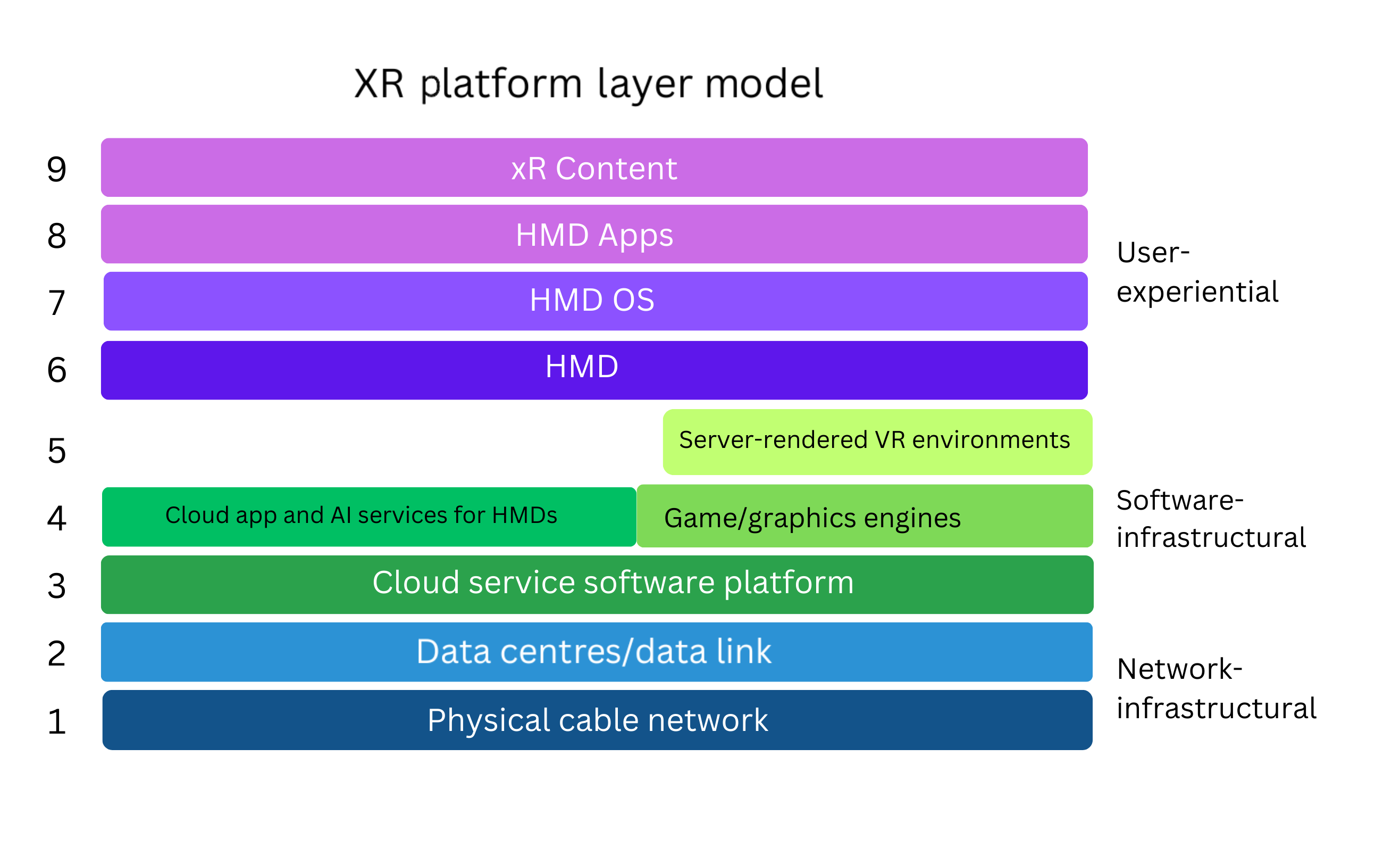
In our model, the lowest two layers form the network-infrastructural base – the physical foundation enabling XR services.1
Layer 1 comprises global and local fibre-optic cable networks and associated infrastructure – repeaters, hubs, and housing facilities – that transmit data and interconnect the data centres underpinning cloud-based XR services.
Layer 2 captures those data centres, whether operated by third-party vendors or owned by vertically integrated firms. Increasingly, companies like Amazon, Google, Microsoft, Alibaba, and Tencent are investing directly in undersea and terrestrial cable infrastructure (Mauldin, 2024), blurring distinctions between physical and digital control.
The next three layers represent software-infrastructural tiers that enable XR development and platform operations.
Layer 3 includes cloud service providers such as AWS, Google Cloud, and Microsoft Azure, which support both XR devices and applications. These backend platforms enable real-time processing for AI-driven wearables like Meta’s Ray-Bans, Amazon Echo Frames, and devices from firms such as Solos, Lucyd, Xreal, and Rokid.
Layer 4 comprises game engines and development platforms, primarily Unity and Unreal Engine, which provide the core tools for building immersive XR environments, cloud-based rendering, and spatial logic (Jungherr & Schlarb, 2022). They also support XR platforms like Roblox and Spatial, enabling interaction, monetisation, and third-party content creation (Mancuso et al., 2023; Schulte & Shemakov, 2024).
Layer 5 bridges backend and user-facing infrastructure through server-side rendering. It offloads graphics processing from local devices to the cloud, reducing hardware demands while deepening platform dependencies (Abilkaiyrkyzy et al., 2023; Alhilal et al., 2023; Raymer et al., 2023).
The final four layers represent the user-experiential dimension of XR systems.
Layer 6 includes devices such as head-mounted displays (HMDs), both tethered and standalone – for instance Meta’s Quest series and Apple’s Vision Pro – that serve as the primary interface for immersive content. Many smart glasses rely on smartphone Bluetooth connections for processing and AI functions (Iqbal & Campbell, 2023; Waisberg et al., 2024). Though they are not necessarily physically unified, we consider sensors and controllers that enable use of the HMD (such as the neural wristband accompanying the Meta Ray-Ban Display smart glasses) as part of the HMD, conceptually.
Layer 7 comprises XR operating systems. Most standalone HMDs run Android-based systems, while Apple’s Vision Pro uses VisionOS. PC-connected devices often run on SteamVR. These operating systems act as multisided platforms, enabling third-party development and distribution.
Layer 8 includes XR applications, which – like the application layer in traditional models – provide core services. However, many also function as platforms themselves, supporting social interaction, user-generated content, and virtual economies. Examples include Horizon Worlds, VRChat, and Roblox (Alhilal et al., 2023; Cheng et al., 2022).
Layer 9 is the interactive content layer: games, 3D spaces, meetings, and other immersive experiences. Unlike traditional content layers, this layer constitutes the main object of user engagement and often operates across multiple platform or application environments.
Taken together, this nine-layer model provides a structured lens through which to understand the complex sociotechnical foundations of the metaverse. It also allows for a clear depiction of the emerging patterns of corporate power in the XR economy.
As shown in Figure 2, several companies operate across multiple layers, with some present at nearly every layer. Notably, the world’s six largest tech companies by market capitalisation – Microsoft, Apple, Meta, Alphabet/Google, Amazon, and NVIDIA – are all active across this layered XR stack. All but NVIDIA primarily rely on platform-based business models as their core source of revenue.
This kind of vertical integration concentrates both economic and sociopolitical power by allowing a few firms to shape the production, distribution, and governance of XR technologies in their interest.
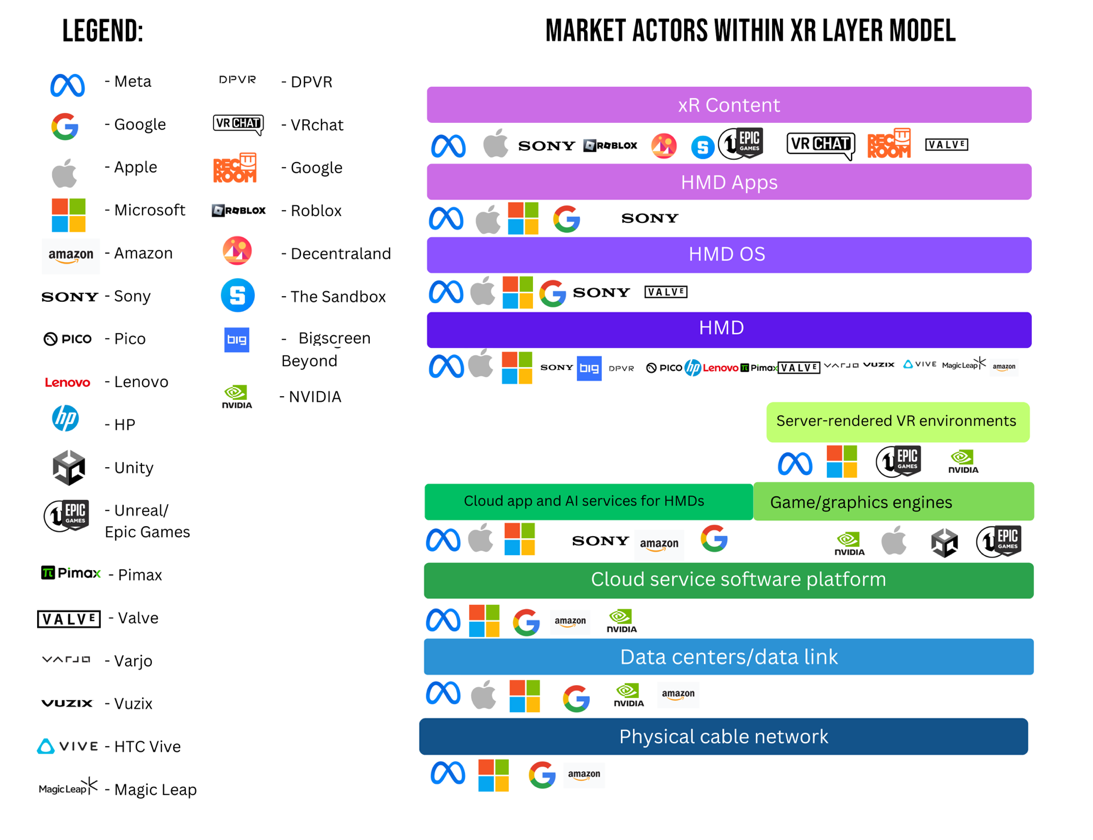
This figure does not underlie the CC BY license like the rest of this article, as it includes trademarks and copyrighted material.
Below we apply this model to Meta, Apple, and Microsoft to demonstrate its utility in assessing market dynamics and informing regulatory design. We analyse their positions within the XR Platform Layer Model and illustrate how each engages in platformisation – including datafication, commodification, and multisided market activities – as well as infrastructuralisation, in ways that consolidate their power across the emerging XR ecosystem.
We excluded Alphabet/Google and Amazon for brevity and because their XR and metaverse integration strategies are less well-defined. Both companies remain important candidates for future analysis, however. Meta, Apple, and Microsoft, on the other hand, have articulated explicit and ambitious XR strategies.
Meta: Deep vertical integration and cross-layer orchestration
Meta’s position in the XR economy exemplifies how platform power can be entrenched through deep vertical integration across technical layers and platformisation processes across market functions. Through ownership and control of infrastructure, operating systems, development environments, content platforms, and identity systems, Meta orchestrates a closed XR ecosystem that amplifies its market power. This cross-layer integration is precisely what makes Meta’s XR strategy so effective – and so difficult to regulate using conventional market segmentation or product-based approaches.
As visualised in Figure 2, Meta is present in nearly every layer of the XR platform layer model. It is the most vertically integrated of the major platform companies, operating from the physical infrastructure level through to user-facing applications and content.
At the network-infrastructural layers, Meta is an investor and co-owner of multiple undersea fibre-optic cables, including the 2Africa project – the world’s largest subsea cable system at the time of writing (2Africa, 2024) – as well as the Anjana cable connecting the US and Europe (Mauldin, 2024). It operates its own global data centres, though unlike AWS or Azure, these only facilitate consumer access to Meta’s own platform products.
At the software-infrastructural layers, Meta relies on both third-party engines (Unity, Unreal) and proprietary development tools. Its cloud-based assistant, Meta AI, powers devices like its Ray-Ban smart glasses, while immersive environments such as Horizon Worlds and Horizon Workrooms depend on server-side rendering for real-time graphics performance (Meta Platforms Inc., 2024a, 2024c).
In the user-experiential layers, Meta dominates the HMD market outside of China through its Quest series and its smartglasses collaboration with eyewear manufacturer EssilorLuxottica (Counterpoint Research, 2025; Francombe, 2025). The Quest devices run on QuestOS, which functions as a multisided platform ecosystem (layers 7–8), enabling third-party development while tightly controlling app distribution. Layer 9 content includes social VR experiences, games, a smart TV-like presentation of commercial streaming services ranging from Prime Video and Peacock to Twitch, and XR versions of Meta’s flagship services.
Meta’s Orion Augmented Reality (AR) prototype HMD provides an AR experience akin to that found in the Quest HMDs, but in a form factor that resembles everyday eyewear (Meta, 2024b). While a commercial launch of Orion is several years away, Meta took the first step in that direction by releasing the Meta Ray-Ban Display smart glasses in September 2025 (Meta, 2025a). This model adds display functionality to the lenses of the Ray-Ban Meta AI glasses, superimposing graphical information such as transcriptions/translations, turn-by-turn directions and AI-generated images and videos onto the user’s visual reality perception.
In line with the Dutch school of platform studies’ platformisation analysis (Poell et al., 2021; van Dijck et al., 2019), what makes Meta’s strategy especially powerful is its orchestration of datafication practices across this stack. Meta captures biometric data through Quest’s sensors – tracking hand, eye, and body movement (Meta Platforms Inc., 2023d). Developers are restricted from using this data for third-party advertising – Meta centralises all monetisation through its own ad infrastructure (Meta Platforms Inc., 2023d, Section 11a), reinforcing control over both data flows and revenue streams.
The Meta Ray-Ban Display’s accompanying neural wristband adds a new dimension to this. It senses minute nerve movements in the wrist, translating small finger gestures and micromovements to UI navigation (Meta, 2025a). This way, Meta operationalises and datafies a person’s neural activity. In the study period it was not clear to what extent Meta commodifies or draws inferences from this data, but the company already has a history of doing so with user affect and behaviour data (Stark, 2020).
Personalised content and app recommendations delivered via the Quest dashboard enable multi-layer lock-in by embedding the user deeper in Meta’s proprietary ecosystem. This is similarly the case for Meta Ray-Ban Display and the company’s other smart glasses models. Users onboard via existing Meta credentials (Facebook, Instagram, WhatsApp), reducing friction and increasing dependency.
The interplay between identity management, content delivery, and proprietary devices produces a self-reinforcing cycle of data extraction, monetisation, and user retention. Meta’s dominance in one internet layer – social media – actively strengthens its position across others in the XR economy, from hardware to immersive content.
This configuration of power is difficult to address through existing antitrust frameworks that focus narrowly on single markets. For instance, investigations in the US and EU have targeted Meta’s social media dominance (Federal Trade Commission, 2020; European Commission, 2022) but they fail to account for the infrastructure-platform entanglements that define its XR strategy. Here, the XR Platform Layer Model offers a diagnostic advantage: it reveals how power is distributed, reinforced, and scaled across layers – not just within them.
This model also supports intersectional regulation. For example, regulators could assess whether Meta’s investment in undersea cables gives it an unfair edge in content delivery to its HMDs (layers 1–6), or whether bundling QuestOS with its Quest devices restricts competition with other XR operating systems (layer 7).
At the app layer (layer 8), Meta currently lacks dominance – Horizon Worlds lags platforms like Roblox – but restrictions on sideloading or third-party stores could lead to future gatekeeping powers. Meta is also platformising its smart glasses with similar gatekeeping limitations. Simultaneously with the Meta Ray-Ban Display, the company announced the Meta Wearable Device Access Toolkit, a suite of app development tools aimed at fostering an app ecosystem for smart glasses.
In short, Meta’s power in XR is not simply a product of market share, but of layer-spanning integration.
It connects infrastructure, data, identity, content, and monetisation into a tightly controlled system. The XR Platform Layer Model highlights dependencies and clarifies where structural separation, open access, or interoperability mandates might be most effective. Crucially, it also challenges the common defence that firms like Meta lack dominance in any single market. Instead, it shows how distributed control can yield concentrated power – precisely the kind that next-generation regulation must address.
Apple: Horizontal integration and ecosystem control
Apple’s entry into the XR market through the Vision Pro headset illustrates a mode of platform power shaped less by vertical integration and more by ecosystem control and strategic horizontal partnerships. While Apple presents the Vision Pro as a unified, seamless product within its tightly controlled ecosystem, the XR Platform Layer Model reveals a more complex reality: Apple’s XR offerings depend on layered collaborations with third-party infrastructure and rendering providers, raising important questions for regulators about opacity, dependency, and competitive advantage.
Apple’s presence in the user-experiential layers is strongest. At layers six and seven, it manufactures the Vision Pro and controls the operating system, VisionOS. Through the App Store (layer eight), it facilitates access to both first-party applications – such as Apple Music and iCloud – and third-party apps, all within Apple’s walled-garden model. At layer nine, Apple produces exclusive XR content, including immersive films and experiences tailored to Vision Pro users (Apple Inc., 2024).
Apple also participates at the software-infrastructural and infrastructural layers, albeit in a more horizontally distributed way than Meta. At layer two, Apple operates its own data centres across the US, China, and Europe. Its iCloud services (layer three) are partially hosted on Google Cloud infrastructure, with over 8 million terabytes of user data reportedly stored on Google’s servers as of 2021.
Vision Pro’s XR content streaming is underpinned by NVIDIA’s Graphics Delivery Network (GDN) and its Omniverse platform – a cloud-based rendering system for 3D virtual environments (layer five). Though Apple does not own Omniverse, it integrates it into its developer stack through RealityKit and SwiftUI tools, effectively creating a seamless Apple-native developer experience (layer four).
For Apple, the XR Platform Layer Model exposes horizontal integration and shared infrastructural dependencies. Apple’s strategy relies on third-party partnerships – especially with Google and NVIDIA – to support its services. The model clarifies how seemingly singular products like the VisionPro are co-constructed across firms and infrastructures. By applying layer separation, regulators can assess whether Apple’s supply arrangements are anti-competitive – for example, whether Google or NVIDIA offer Apple preferential terms not extended to rivals.
The XR layer model also suggests Apple’s “walled garden” narrative masks underlying platform complexity. From the user perspective, the VisionPro offers a cohesive, closed Apple experience. But the XR Platform Layer Model shows a more fragmented reality: Apple coordinates data extraction and commodification across multiple layers through licensing, integration, and developer policies.
The model helps unpack this complexity, making hidden dependencies and constraints legible for regulators. Recent rulings in the US and EU have challenged Apple’s 30% commission on in-app purchases and its prohibition of third-party app stores – focused primarily on layer eight. However, these interventions have not fully accounted for how Apple’s dominance in adjacent markets (e.g., iOS, iCloud) enables it to also consolidate power in the XR space. A layer-model approach could help regulators identify leverage points for interventions – such as mandating cross-platform interoperability, fair infrastructure access, or user control over application environments.
Ultimately, Apple’s VisionPro does not represent a break from its platform logic but an extension of it. Like Meta, Apple is shaping the XR ecosystem according to its established business model: closed hardware, controlled software, and deep user lock-in. However, its method differs in important ways. Apple relies more on strategic horizontal integration, embedding third-party infrastructure within a curated Apple environment. This contrast underscores the value of the XR Platform Layer Model – not just in tracing power, but in enabling comparative analysis of how that power is constructed and exercised across the emerging metaverse economy.
Microsoft: Infrastructuralisation without hardware
Microsoft’s strategy in the XR economy is defined by infrastructural reach and enterprise integration. While Meta seeks platform lock-in and Apple is cultivating a controlled closed-device ecosystem, Microsoft is positioning itself as the foundational service provider for enterprise XR – embedding its tools, infrastructure, and AI services across third-party devices and industrial applications.
This approach reflects the company’s broader role in the digital economy, where it exerts outsized influence through cloud infrastructure, enterprise software, and developer ecosystems – without needing to own the final consumer interface.
In 2023, Microsoft formalised this direction with the rebranding of its “industrial metaverse” initiative to Microsoft XR for Enterprises (Carter, 2025). Key offerings include Microsoft Mesh, which enables avatar-based virtual meetings through Quest headsets and desktop interfaces, integrated into Microsoft Teams (Microsoft, 2024). Microsoft 365 apps – Word, Excel, PowerPoint – are also now available on Quest and Vision Pro, enabling immersive productivity. On the consumer side, Xbox Game Pass supports immersive gaming on Quest, simulating large-format displays in virtual space.
While these XR services are increasingly visible, Microsoft’s real strength lies in the underlying infrastructure. At layer one, it invests in subsea cables (Mauldin, 2024); at layer two, it operates over 300 data centres in 60 global regions (Microsoft, 2024); and at layer three, its Azure platform powers a wide range of XR and AI workloads (Haranas, 2024). Microsoft has cultivated high-value enterprise partnerships that rely on these layers – most notably a 2024 alliance with Siemens to deliver cross-industry AI services deployed through Sony’s MR headsets for industrial use cases (Siemens AG, 2023; Takahashi, 2024).
At layer four, Microsoft’s integration with OpenAI’s Copilot enables AI assistance within immersive enterprise tools like Dynamics 365 Guides, which spatially overlays instructional content for frontline workers (Cheng, 2023). Layer five includes Microsoft Mesh, supporting cloud-rendered XR environments for meetings, design, and collaboration.
Layer eight spans XR-enabled applications – Microsoft 365, Xbox Game Pass, and Dynamics 365 – while layer nine includes the immersive outputs these platforms generate, including VR workspaces, digital twins, and enterprise simulations.
Microsoft is absent from layers six and seven – the HMD hardware and OS layers. Once a contender with its HoloLens devices, the company formally exited the proprietary XR hardware market in 2025, withdrawing from its U.S. Army contract and discontinuing further development (Subin, 2025). This pivot affirms Microsoft’s device-agnostic strategy: rather than owning the interface, it embeds its services across XR ecosystems built by others.
Microsoft’s current XR strategy represents a form of infrastructuralisation. It seeks to make itself indispensable not by locking users into proprietary devices, but by saturating the XR stack with enterprise tools, cloud services, and AI integrations. This is essentially a replication of its dominance in productivity software and cloud computing but within the XR economy.
The XR platform layer model is critical for grasping the full extent of this influence. In contrast to Meta’s vertical integration or Apple’s ecosystem opacity, Microsoft’s power is more diffuse – spread across infrastructure, partnerships, and application services. The model helps map this distributed presence and clarifies where Microsoft is a supplier, a coordinator, or a controller of XR functions. For example, it distinguishes between cases where Microsoft provides just the cloud layer (e.g., Azure for third-party apps) versus end-to-end service delivery (e.g., Mesh or Copilot-based XR applications).
For regulators, this layered visibility is useful. Microsoft’s decentralised, partnership-driven model risks obscuring the extent of its market consolidation and the XR layer model supports an assessment of cumulative influence across services and partnerships and helps clarify whether Microsoft–or its collaborators–control critical portions of the stack.
It also supports comparisons across contexts: Is Microsoft merely enabling a service, or is it building dependencies that undermine openness? As Microsoft positions itself as the enterprise provider of the metaverse, ensuring fair competition will depend on the ability to diagnose stack-level control – not just market-by-market dominance. The XR Platform Layer Model provides a necessary analytical scaffold for this task, revealing how infrastructural power may become the most important – and least visible – form of dominance in the future of XR.
Policy insights from a layered XR economy analysis
The metaverse is not a single technology or product but a complex sociotechnical system of interconnected infrastructures, platforms, standards and content layers. Emerging metaverse governance frameworks from the European Union (2024), the United States (Vesco, 2025), China (Gray & Tang, 2025), and Australia (Gray, 2025) prioritise safety and increased innovation and largely ignore the infrastructural sites of platform power and control discussed here. The XR layer model introduced here provides a framework for making this complexity legible, both analytically and regulatorily.
Our analysis shows that the metaverse is already being shaped by existing platform giants. Meta, Apple, Microsoft, Alphabet/Google and Amazon are embedding themselves across multiple layers of the XR ecosystem through vertical integration, ecosystem lock-in and infrastructural partnerships, extending their dominance from adjacent digital markets into immersive technologies.
Comparison with earlier internet layer models (Claffy & Clark, 2014) reveals a familiar trajectory: the emergence of new bottlenecks where a few actors control access, extract rents, and set standards. These include cloud rendering services, head-mounted device ecosystems, proprietary operating systems, and AI-driven content gateways. Without intervention, the metaverse risks replicating today’s platform monopolies in even more intimate and immersive forms.
A layered regulatory approach enables policymakers to distinguish between technical, infrastructural, and market functions, allowing interventions where power concentrates. In some international jurisdictions, regulators are already moving in the direction of a more layered approach, exemplified in the EU by the structure of the DSA and in the enforcement of the DMA. The DSA contains classifications of platforms such as ‘Mere Conduit’, ‘Hosting’, and ‘Caching’, which can also be conceptualised as layers in a layer model (Regulation (EU) 2022/2065). However, as we will argue below, this does not necessarily provide an option for combining, for example, a ‘Mere Conduit’ platform with a user-facing service that relies on it, and which is in itself classifiable as a platform. Using a layer model such as the one proposed here as an interpretive device turns what is now an intimation toward layers in the law text into a regulatory device that can address all loci of platform power in complex platform systems, even if the latter appears on the surface to be only a single platform.
Similarly, when the European Commission took action against Apple and Google in 2025 for violations of the DMA, it did so by targeting app store access (Chee, 2025; Schrepel, 2024; Wörsdörfer, 2024). This can be seen as an intimation toward a layered approach in that the Commission targeted a single layer that underpins several other platforms such as smartphones and app development platforms. However, as in the DSA case, this approach may also overlook accumulations of platform power that stem from the complexity of what is essentially a multi-platform system with many combination options. This too is a case in which a layer model would be beneficial in revealing platform power concentrations in the systems.
An analysis of Meta’s Wearable Device Access Toolkit serves as an example of how layer models can reveal anti-competitive practices that current approaches to complex platform systems might overlook. While the toolkit grants developer access to cameras, microphones, and speakers in Meta’s smart glasses, it withholds display and neural wristband capabilities. Despite promises of openness, these features remain exclusive to Meta’s apps, likely contravening the DMA’s rules against leveraging cross-platform advantages (Regulation (EU) 2022/1925).
Similar concerns surround Apple’s Vision Pro, given its developer restrictions and recent antitrust findings (Satariano, 2024; Liedtke et al., 2024). Separating user-experiential layers from underlying infrastructure helps regulators pinpoint where such affordances may breach competition law, even when upper layers appear compliant.
Critics once argued that layered regulation risks regulators picking ‘winners and losers’ (Reed, 2005) or creating rigidity. Yet, this assumes markets self-correct – a claim undermined by platform capitalism. In practice, layered approaches have proved adaptive, especially when focused on interoperability, transparency and access.
Two regulatory imperatives follow from our analysis: ensuring transparency and open standards and addressing concentrated market power. Regulators must resist the opacity of closed ecosystems such as Meta’s Quest and Apple’s VisionOS by mandating interoperability, portability, and open APIs. A layered model can clarify where openness is lost and where it can be restored.
Platform-focused regulation alone cannot confront XR’s power structures. As seen in Meta’s and Apple’s headsets, compliance at the application layer does not ensure fairness across deeper hardware or operating system layers. Layer models reveal these hidden dependencies and clarify compliance challenges otherwise obscured by corporate complexity.
Meta’s XR products exemplify this interdependence. They depend on the same data and network infrastructures as Facebook and Instagram. Meta’s earlier requirement that Quest users log in through social media accounts – abandoned only after backlash – illustrates how cross-layer lock-in can occur. Notably, Meta’s Ray-Ban AI-enabled glasses largely restrict users to Meta’s platforms, echoing Apple’s App Store exclusivity (Meta Platforms Inc., 2025c; Chee, 2025; Satariano, 2024).
Since Meta’s XR offerings, such as the Ray-Ban AI glasses, or the more recent Meta Ray-Ban Display glasses, have not yet accrued the monthly active user numbers that would classify the company’s XR platforms as VLOPs, they are not subject to the extra scrutiny of that tier. This means, for example, that Meta’s smartglasses platforms are only subject to annual transparency reporting, whereas Meta-owned VLOPs such as Facebook and Instagram must provide transparency reports every six months and Meta, in its role of an online platform provider, is required to provide monthly active user numbers at the same time intervals.
Meta is also not required to establish an independent compliance function for their XR platforms. The requirements of the DSA are articulated to be specific to the individual service from a given provider (Regulation (EU) 2022/2065, recital 15). Consequently, the annual, independent audits that the DSA subject providers of VLOPs to, do not encompass platforms operated by that provider which do not qualify as VLOPs, and Meta’s XR offerings are thus not required to be audited as part of Meta’s annual independent audits.
Similarly, Meta is not required to include the XR offerings in the systemic risk assessments they are required to provide for its VLOPs. Meta’s XR platforms would be no more of a concern in this context than any other non-VLOP in the market, were it not for the shared, Meta-owned cloud infrastructures and AI systems those XR platforms rely on. It could be argued that because those resources are also shared by Meta’s VLOPs, their compliance with the DSA is ensured.
However, it is entirely possible that XR platform functionalities and affordances may combine with shared information infrastructure functionalities and other in-house capabilities in new and hitherto unseen ways. It is also entirely possible that the accountability measures in the DSA are oblivious to these new combinations because only the infrastructure elements in them are subject to extra VLOP scrutiny, and the elements constituted by the XR platform offering are only subject to the standard platform regulations in the DSA. This way, the new combinations may carry the same level of risk that the VLOP tier in the DSA is intended to mitigate, but because the XR platform is classified as non-VLOP, the risk is never addressed.
There are, in essence, two ways of addressing this dilemma. While there seems to be a research gap specifically with regard to the sharing of resources between a standard platform and a VLOP in the DSA, some scholars have discussed similar issues. Wolters, et al. (2025) call upon the European Commission to amend the DSA with more specificity – or at least clarify policies at the enforcement level – when it comes to regulation of complex, multi-entity providers. They are prompted by the dual nature of online ad networks as both infrastructures and platforms. Similarly, Lorente and Gardhouse (2026) argue that the DSA’s distinction between VLOPs and VLOSEs (Very Large Online Search Engines) breaks down in the case of ChatGPT, as it can be used as both. These articles point to definitional issues in the DSA, and better definitions could potentially remedy the shared resources dilemma above, by, for example, letting VLOP classifications apply at the provider level rather than the platform level. This would likely be met with strong pushback from industry advocates, however, as well as require costly and complex reconfigurations of DSA enforcement mechanisms.
The other way to address the dilemma is the layered model we propose here. By applying a layer model similar to the one detailed above as an interpretational lens for the DSA, policy practice and enforcement may be informed by how the DSA’s distinction between standard online platforms and VLOPs may apply at each network-infrastructural, software-infrastructural, or user-experiential layer in isolation – or in combination.
Rather than, for example, merely interpreting HMD apps or HMD OS’es as individual platforms whose compliance with the DSA should be assessed, it becomes possible to view each of them in combination with the Cloud Service Software Platform layer. Applying Meta’s case to this layer model, the Cloud Service Software Platform layer shared by Meta’s products is arguably a VLOP on its own, given that it meets the definition in the DSA of a both a “Caching” and a “Hosting” service (Regulation (EU) 2022/2065, Art. 3(g)), it meets the definition of a platform as defined by Claffy and Clark (2014), and it serves far more than 45 million monthly active users.
The layer model similarly elucidates dependencies, such as how Meta’s XR platforms are dependent on the shared resources constituting the Cloud Service Software Platform layer. The demonstration of such dependencies strengthens the argument that Meta’s XR platforms should be classified as VLOPs even though they qualify as such at the infrastructural, rather than the user-facing platform level. The layer model approach thus provides policymakers and regulators with both more technological awareness and actionability at a more granular level when interpreting the DSA for the purpose of application to an actual case.
Across XR, firms such as Meta, Apple, and Microsoft are consolidating control across multiple layers, governing developer access, user identity, monetisation, and content visibility. These are not isolated market behaviours but stack-level configurations of power. The XR Platform Layer Model provides regulators with tools to identify these configurations and design interventions that address systemic, cross-layer dominance.
The metaverse is being built by corporations whose incentives favour enclosure, lock-in and asymmetrical control. Preserving openness, diversity, and competition in this next phase of digital life will require regulatory frameworks capable of diagnosing power across the entire technological stack.
Conclusion
Our paper shows that platform power in XR is exercised through cross-layer integration and orchestration, not only through dominance within isolated product markets, and requires a multi-layered regulatory response that strikes at the underlying structures reproducing private power.
Our analysis also contains a central message for regulators: the big tech companies are poised to establish early positions of dominance in the emerging XR economy. The metaverse may be speculative, but the technologies behind it are nevertheless under construction. They are being shaped by the architectural decisions and business strategies of the platform companies that already have excessive economic and social power.
If regulators dismiss XR as niche or speculative, they will lose an important opportunity to take action to avoid repeating the failures of internet and social media governance.
References
2Africa. (2024). Partners. 2Africa Cable. https://www.2africacable.net/partners
Abbate, J. (2000). Inventing the internet. MIT press.
Abilkaiyrkyzy, A., Elhagry, A., Laamarti, F., & Elsaddik, A. (2023). Metaverse key requirements and platforms survey. IEEE Access. https://doi.org/10.1109/ACCESS.2023.3325844
Alhilal, A., Shatilov, K., Tyson, G., Braud, T., & Hui, P. (2023). Network traffic in the Metaverse: The case of social VR. 2023 IEEE 43rd International Conference on Distributed Computing Systems Workshops (ICDCSW). https://doi.org/10.1109/ICDCSW60045.2023.00025
Apple, Inc. (2023a). Adopting best practices for privacy and user preferences. Apple Developer Documentation. https://developer.apple.com/documentation/visionos/adopting-best-practices-for-privacy
Apple, Inc. (2023b). Eyes. Apple Developer Documentation. https://developer.apple.com/design/human-interface-guidelines/eyes
Apple, Inc. (2023, June 4). Apple Vision Pro. Apple. https://www.apple.com/apple-vision-pro/
Chee, F. Y. (2025, March 19). Google, Apple hit by EU regulatory crackdown. Reuters. https://www.reuters.com/technology/google-hit-with-2-charges-under-landmark-eu-rules-risks-fines-2025-03-19/
Cheng, L. (2023, November 15). Introducing Copilot in Microsoft Dynamics 365 Guides. Microsoft Industry Blogs. https://www.microsoft.com/en-us/industry/blog/industrial-metaverse/2023/11/15/introducing-copilot-in-microsoft-dynamics-365-guides-bringing-generative-ai-in-mixed-reality-to-frontline-workers/
Cheng, R., Wu, N., Chen, S., & Han, B. (2022). Reality check of Metaverse: A first look at commercial social virtual reality platforms. 2022 IEEE Conference on Virtual Reality and 3D User Interfaces Abstracts and Workshops (VRW), 141–148.
Claffy, K. C., & Clark, D. (2014). Platform models for sustainable Internet regulation. Journal of Information Policy, 4, 463–488. https://doi.org/10.5325/jinfopoli.4.2014.0463
Clark, D. D. (2018). Designing an internet. MIT Press.
Collings, P., Hancock, A., & Schmon, C. (2025, December 25). Age verification threats across the globe: 2025 in review. Electronic Frontier Foundation. https://www.eff.org/deeplinks/2025/12/age-verification-threats-across-globe-2025-review
Counterpoint Research. (2025). Global XR (AR & VR Headsets) market share: Quarterly. https://counterpointresearch.com/en/insights/global-xr-ar-vr-headsets-market-share-quarterly
Dewitte, P. (2023). A brief history of data protection by design: From multilateral security to Article 25 (1) GDPR. Technology and Regulation, 2023, 80–94.
Egliston, B., & Carter, M. (2021). Critical questions for Facebook’s virtual reality: Data, power and the metaverse. Internet Policy Review, 10(4). https://doi.org/10.14763/2021.4.1610
Egliston, B., & Carter, M. (2022a). Oculus imaginaries: The promises and perils of Facebook’s virtual reality. New Media & Society, 24(1), 70–89.
Egliston, B., & Carter, M. (2022b). ‘The interface of the future’: Mixed reality, intimate data and imagined temporalities. Big Data & Society, 9(1), 20539517211063689.
Egliston, B., & Carter, M. (2022c). ‘The metaverse and how we’ll build it’: The political economy of Meta’s Reality Labs. New Media & Society, 14614448221119785.
Egliston, B., Carter, M., & Clark, K. E. (2024). Who will govern the metaverse? Examining governance initiatives for extended reality (XR) technologies. New Media & Society, 14614448231226172.
European Commission. (2022). Antitrust: Commission sends Statement of Objections to Meta [Text]. European Commission - European Commission. https://ec.europa.eu/commission/presscorner/detail/it/ip_22_7728
European Commission. (2024). Commission opens formal proceedings under DSA [Text]. European Commission - European Commission. https://ec.europa.eu/commission/presscorner/detail/en/ip_24_2373
European Commission. (2025). Supervision of the designated very large online platforms and search engines under DSA. Shaping Europe’s Digital Future. https://digital-strategy.ec.europa.eu/en/policies/list-designated-vlops-and-vloses
European Parliament, C. of the E. U. (2022). Regulation (EU) 2022/2065 of the European Parliament and of the Council of 19 October 2022 on a Single Market For Digital Services and amending Directive 2000/31/EC. Official Journal of the European Union, L(277), 1–102.
European Parliament, Madiega, T., Car, P., Niestadt, M., & Van de Pol, L. (2022). Metaverse—Opportunities, risks and policy implications. European Parliament. https://www.europarl.europa.eu/cmsdata/268589/eprs-briefing-metaverse_EN.pdf
Evans, D. S., & Schmalensee, R. (2016). Matchmakers: The new economics of multisided platforms. Harvard Business Review Press. https://books.google.com/books?hl=en&lr=&id=pIhZCwAAQBAJ&oi=fnd&pg=PR9&dq=evans+schmalensee+matchmakers&ots=0DZsgopDj8&sig=RJON7jlVQ-hSscRfLsqLi8Udiw8
Federal Trade Commission. (2020, December 9). FTC sues Facebook for illegal monopolization. Federal Trade Commission. https://www.ftc.gov/news-events/news/press-releases/2020/12/ftc-sues-facebook-illegal-monopolization
Flew, T. (2021). Regulating platforms. John Wiley & Sons. https://books.google.com/books?hl=en&lr=&id=fI1SEAAAQBAJ&oi=fnd&pg=PA1986&dq=flew+t+2021+regulating+platforms&ots=9IYQNBqlz8&sig=HI8Pp1h-ZvCoe__VN6BR8VYqVmU
Flew, T., & Martin, F. R. (2022). Digital platform regulation: Global perspectives on internet governance. Springer. https://idp.springer.com/authorize/casa?redirect_uri=https://link.springer.com/content/pdf/10.1007/978-3-030-95220-4.pdf&casa_token=A2vgg0iaSbYAAAAA:r4kASV4zWS98AKyQqJ7aJCulxSvfG71-psuq2h5IetG8dOIse6jrhvjvhXp8dvhudvE3ztfBYoivrArG
Francombe, A. (2025). Meta has already won the smart glasses race. WIRED. https://www.wired.com/story/meta-has-already-won-the-smart-glasses-race/
Gray, J. E., & Tang, W. (2025). The Chinese metaverse: An analysis of China’s policy agenda for extended reality (XR). Policy & Internet, 17(1), e418.
Green, P. (1980). An introduction to network architectures and protocols. IEEE Transactions on Communications, 28(4), 413–424. https://doi.org/10.1109/TCOM.1980.1094703
Gurman, M. (2025, April 13). Apple readies pair of headsets while still looking ahead to glasses. Bloomberg.Com. https://www.bloomberg.com/news/newsletters/2025-04-13/apple-vision-pro-2-details-low-latency-headset-ar-glasses-ipados-19-details-m9flf1fd
Haranas, M. (2024, May 6). AWS, Google, Microsoft battle over $76B Q1 cloud market share. https://www.crn.com/news/cloud/2024/aws-google-microsoft-battle-over-76b-q1-cloud-market-share
Heath, A. (2024, September 25). Hands-on with Orion, Meta’s first pair of AR glasses. The Verge. https://www.theverge.com/24253908/meta-orion-ar-glasses-demo-mark-zuckerberg-interview
Iqbal, M. Z., & Campbell, A. G. (2023). Adopting smart glasses responsibly: Potential benefits, ethical, and privacy concerns with Ray-Ban stories. AI and Ethics, 3(1), 325–327. https://doi.org/10.1007/s43681-022-00155-7
Jungherr, A., & Schlarb, D. B. (2022). The extended reach of game engine companies: How companies like Epic Games and Unity Technologies provide platforms for extended reality applications and the Metaverse. Social Media+ Society, 8(2), 20563051221107641.
Lehr, W., Clark, D. D., Bauer, S., & Claffy, K. C. (2019). Regulation when platforms are layered. https://doi.org/10.2139/ssrn.3427499
Lehr, W., & Sicker, D. (2019). Telecom déjà vu: A model for sharing in the broadband Internet. Information & Communications Technology Law, 28(3), 275–310. https://doi.org/10.1080/13600834.2019.1653546
Leone de Castris, A. (2025). Types of platform transparency: An analysis of discourse around transparency and global digital platforms. Public Integrity, 27(3), 340–354.
Liedtke, M., Whitehurst, L., Balsamo, M., & Bajak, F. (2024, March 21). Justice Department sues Apple, alleging it illegally monopolized the smartphone market. AP News. https://apnews.com/article/apple-antitrust-monopoly-app-store-justice-department-822d7e8f5cf53a2636795fcc33ee1fc3
Lorente, T., & Gardhouse, K. (2026). Between search and platform: ChatGPT under the DSA. Internet Policy Review, 15(1). https://doi.org/10.14763/2026.1.2084
Mancuso, I., Petruzzelli, A. M., Panniello, U., & Nespoli, C. (2023). A microfoundation perspective on business model innovation: The cases of roblox and meta in metaverse. IEEE Transactions on Engineering Management. https://doi.org/10.1109/TEM.2023.3275198
Mauldin, A. (2024, June 27). A (refreshed) list of content providers’ submarine cable holdings. https://blog.telegeography.com/telegeography-content-providers-submarine-cable-holdings-list-new
Meta Platforms, Inc. (2021, June 16). Testing in-headset VR ads. Meta Quest Blog. https://www.oculus.com/blog/testing-in-headset-vr-ads/
Meta Platforms, Inc. (2022). Introducing Meta accounts: A new login for VR. Meta Blog. https://www.meta.com/blog/meta-accounts/
Meta Platforms, Inc. (2023, November 14). Developer data use policy (Updated November 14, 2023). Developer.Oculus.Com. https://developer.oculus.com/policy/data-use/
Meta Platforms, Inc. (2024, September 25). Introducing Orion, our first true augmented reality glasses. Meta Newsroom. https://about.fb.com/news/2024/09/introducing-orion-our-first-true-augmented-reality-glasses/
Meta Platforms, Inc. (2025, September 18). Meta Ray-Ban display: AI glasses with an EMG wristband. Meta Newsroom. https://about.fb.com/news/2025/09/meta-ray-ban-display-ai-glasses-emg-wristband/
Microsoft. (2024). Microsoft datacenters. Microsoft Datacenters. https://datacenters.microsoft.com/
Poell, T., Nieborg, D. B., & Duffy, B. E. (2021). Platforms and cultural production. John Wiley & Sons.
Raymer, E., MacDermott, Á., & Akinbi, A. (2023). Virtual reality forensics: Forensic analysis of Meta Quest 2. Forensic Science International: Digital Investigation, 47, 301658. https://doi.org/10.1016/j.fsidi.2023.301658
Reed, D. P. (2005). Critiquing the layered regulatory model. J. on Telecomm. & High Tech. L., 4, 281.
Reid, B. E. (2020). Internet architecture and disability. Ind. LJ, 95, 591.
Satariano, A. (2024, July 11). Apple settles EU case by opening its payment service to rivals. The New York Times. https://www.nytimes.com/2024/07/11/business/apple-european-union-antitrust.html
Savin, A. (2018). EU regulatory models for platforms on the content carrier layers: Convergence and changing policy patterns. NJCL, 7.
Schrepel, T. (2024). The Apple Music streaming case: The Good, The Bad, and The Ugly. Network Law Review. Spring.
Schulte, P., & Shemakov, R. (2024). The future of digital infrastructure: Case studies of gobal corporate strategies in augmented reality. In H.-Y. Chen, P. Jenweeranon, & N. Alam (Eds), Global Perspectives in the Metaverse (pp. 119–143). Springer Nature Switzerland. https://doi.org/10.1007/978-3-031-54802-4_7
Siemens AG. (2023, January 8). Sony HMD for NX Immersive Designer. Siemens Digital Industries Software. https://www.sw.siemens.com/en-US/digital-transformation/sony-head-mounted-display-vr/
Srnicek, N. (2017a). Platform capitalism. Polity Press.
Srnicek, N. (2017b). The challenges of platform capitalism: Understanding the logic of a new business model. Juncture, 23(4), 254–257.
Stark, L. (2020). The emotive politics of digital mood tracking. New Media & Society, 22(11), 2039–2057. https://doi.org/10.1177/1461444820924624
Stocker, V. (2013, October). On the weal and woe of internet traffic management in Europe: A critical appraisal from a network economic perspective. 24th European Regional Conference of the International Telecommunications Society (ITS): ‘Technology, Investment and Uncertainty’,.
Takahashi, D. (2024, January 9). Siemens teams up with Microsoft on cross-industry AI adoption. VentureBeat. https://venturebeat.com/ai/siemens-teams-up-with-microsoft-on-cross-industry-ai-adoption/
Thierer, A. (2006). Are “dumb pipe” mandates smart public policy? Vertical integration, net neutrality, and the network layers model. In Net neutrality or net neutering: Should broadband Internet services be regulated (pp. 73–108). Springer.
Van Dijck, J., Nieborg, D., & Poell, T. (2019). Reframing platform power. Internet Policy Review, 8(2), 1–18.
Van Dijck, J., Poell, T., & De Waal, M. (2018). The platform society: Public values in a connective world. Oxford University Press.
Waisberg, E., Ong, J., Masalkhi, M., Zaman, N., Sarker, P., Lee, A. G., & Tavakkoli, A. (2024). Meta smart glasses—Large language models and the future for assistive glasses for individuals with vision impairments. Eye, 38(6), 1036–1038. https://doi.org/10.1038/s41433-023-02842-z
Whitt, R. S. (2003). A horizontal leap forward: Formulating a new communications public policy framework based on the Network Layers Model. Fed. Comm. LJ, 56, 587.
Wolters, P., & Zuiderveen Borgesius, F. (2025). The EU Digital Services Act: What does it mean for online advertising and adtech? International Journal of Law and Information Technology, 33, eaaf004.
Woodley, G., See, Harrison. W., O’Neill, B., Green, L., Staksrud, E., & Haskell-Dowland, P. (2025). Australian teen voices on age verification and age assurance measures. Policy & Internet, 17(4), e70019. https://doi.org/10.1002/poi3.70019
Wörsdörfer, M. (2024). Apple’s antitrust paradox. European Competition Journal, 20(1), 113–146. https://doi.org/10.1080/17441056.2023.2262870
Zimmermann, H. (1980). OSI reference model-the ISO model of architecture for open systems interconnection. IEEE Transactions on Communications, 28(4), 425–432. https://doi.org/10.1109/TCOM.1980.1094702
Footnotes
1. These correspond to the “Physical” and “Data Link” layers in the OSI model, and to the combined “Network Access Layer” in the TCP/IP framework.